The Spice Aisle
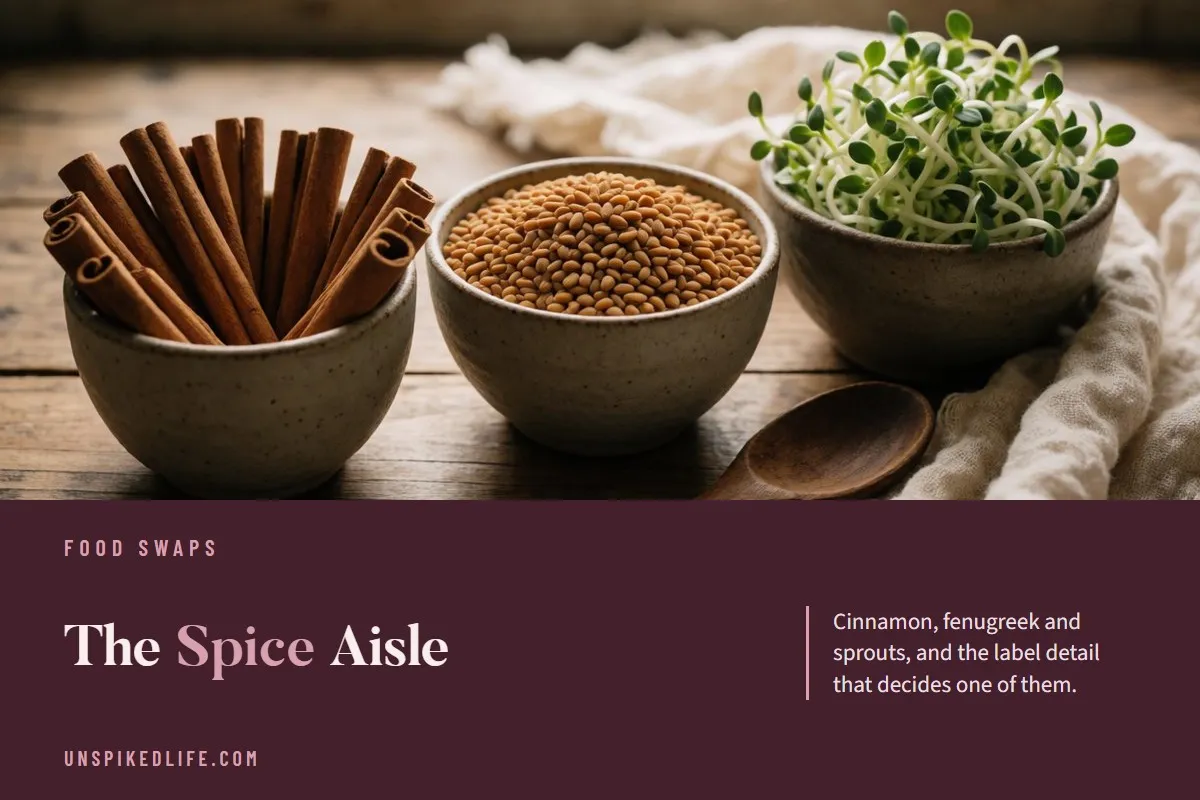
Everything on the shelf claims to do something.
Turmeric for one thing, cinnamon for another, apple cider vinegar for all of it. The claims arrive with no mechanism behind them, so there is no way to judge them. After a while you stop reading and buy the one your friend mentioned.
Three things in that aisle are worth knowing about, because in each case there is a specific thing happening rather than a vague benefit. There is also a label detail on one of them that matters more than the choice of whether to use it at all.
None of this is a substitute for what you eat. All three are cheap, and each has a mechanism you can actually check, which is the only reason they are worth a page.
1. Cinnamon, and the Ceylon question
Cinnamon does two small things at once. Its plant compounds have an effect on how steadily blood sugar rises after a meal, and it slows how fast the stomach empties. Both nudge the same lever this whole site is about, which is how fast a meal arrives.
That is the same lever as fibre, as protein first, as a walk. Different route, same door.
The effect is small. It is a sprinkle on food you already eat, and it is not an intervention. Nobody’s afternoon was ever rescued by cinnamon alone.
Here is the part worth the article. There are two kinds sold as cinnamon, and almost every jar in a supermarket is the cheaper one, called Cassia. Cassia is high in a compound called coumarin, which can put a load on the liver at a daily half-teaspoon.
Ceylon cinnamon has far less of it. If you use cinnamon occasionally, on an apple crumble twice a year, none of this matters. If you are going to sprinkle it on something every morning, buy Ceylon.
Practical: it is usually labelled Ceylon or “true cinnamon”, it is lighter in colour, and the sticks crumble rather than curling into a hard tube. It costs more, and a jar still lasts months.
How to use it: about half a teaspoon, on something you already eat. Porridge, coffee, yoghurt, berries.
Doing it most days beats doing a lot of it once. There is nothing to be gained from a bigger spoon, and there is the coumarin question if the jar is the cheap kind.
2. Fenugreek seeds
This one is less familiar and more interesting.
A teaspoon of fenugreek seeds, soaked in water overnight, does two things. The seeds carry a gel-forming fibre, which does exactly what soluble fibre always does and slows the meal down.
The second thing is more specific. A compound in the seed prompts the body to release insulin when glucose is already high, rather than pushing insulin at rest. Which is a more sensible behaviour than most things sold as helpful. It is not pushing a lever all day. It responds when there is something to respond to.
Practical: a teaspoon of seeds in a glass of water overnight. In the morning, drink the water and eat the softened seeds. Or put the soaked seeds into a curry, which is where they belong anyway. They taste faintly of maple and slightly bitter. You will find them in any South Asian grocer for very little, and in the supermarket for four times as much.
Honest caveat: this is a food, and it is doing a small thing. It is on this page because the mechanism is specific and it costs almost nothing, not because it changes an afternoon on its own.
3. Broccoli sprouts
Not broccoli. The sprouts, which are the three-day-old seedlings, and they are a different proposition.
Sprouts carry far more of the active compound than grown broccoli does. That compound switches on the body’s own defences against damage.
Why it matters here: inflammation is part of what makes cells slow to hear insulin. Calming it sits upstream of what the rest of this site works on directly.
It is short-lived in the body, which means a small amount several times a week beats a big handful once.
Practical: they are sold in tubs next to the salad, they cost more than they look like they should, and they taste peppery. A small handful on a sandwich or in a salad is the whole idea. You can also grow them in a jar on the windowsill for pennies. That sounds like a hobby, and it is about four minutes a day, and plenty of people find they like it.
4. What these three have in common
Each one is doing something specific and small.
That is worth saying because the spice aisle is where health advice goes to become vague. A jar with a claim on the front and no mechanism behind it is asking you to take it on trust. There are two hundred of those in one aisle, and they cannot all be right.
The question to ask any jar is: what is it doing, and to what? If the answer is a sentence about how a meal digests or how a signal is sent, the claim can be checked. If the answer is that it supports wellness, you are buying a font.
Applied to these three. Cinnamon slows how fast the stomach empties. Fenugreek’s fibre gels, and its compound prompts a response only when glucose is already high. Sprouts switch on a defence.
Each of those is a claim you can weigh, argue with, or go and read about. That is the difference.
5. What they will not do
Being clear, because these things get oversold badly.
None of these replaces the order you eat a meal in, ten minutes of walking afterwards, protein at breakfast or a decent night’s sleep. All four of those do more, and all four are free.
Sprinkling cinnamon on a bowl of cereal does not make the cereal a different food. The mechanism is small and it works on the margin of a meal. If the meal itself is a fast one, the margin is not where the problem is.
Use these as the fifth thing you do, not the first.
That ordering is the honest version, and it is why this page sits under food swaps rather than at the front of the site. It is a good page to read once you have the basics running.
Start with one
Buy Ceylon cinnamon, and put half a teaspoon on something tomorrow morning.
That is the smallest and cheapest thing on this page, and if you already use cinnamon it is not even a new habit. It is the same habit, with a better jar.
Put it next to the kettle rather than in the cupboard. Habits that need a cupboard door opened have a worse survival rate than habits that are already on the counter.
Leave the fenugreek and the sprouts for now. One at a time, a fortnight each, and only add the next one if the last one actually stuck.
And the usual warning, which applies here more than anywhere: adding is not swapping. A jar of something good on the shelf above an unchanged dinner is a jar on a shelf.
This article is education, not medical advice. Nothing here is an assessment of you or your health. Talk to your doctor before changing anything, especially if you take any medication.
This is general education about food and daily habits, not medical advice. Talk to your own clinician before changing anything, particularly if you take prescribed medication.