The Order You Eat It In
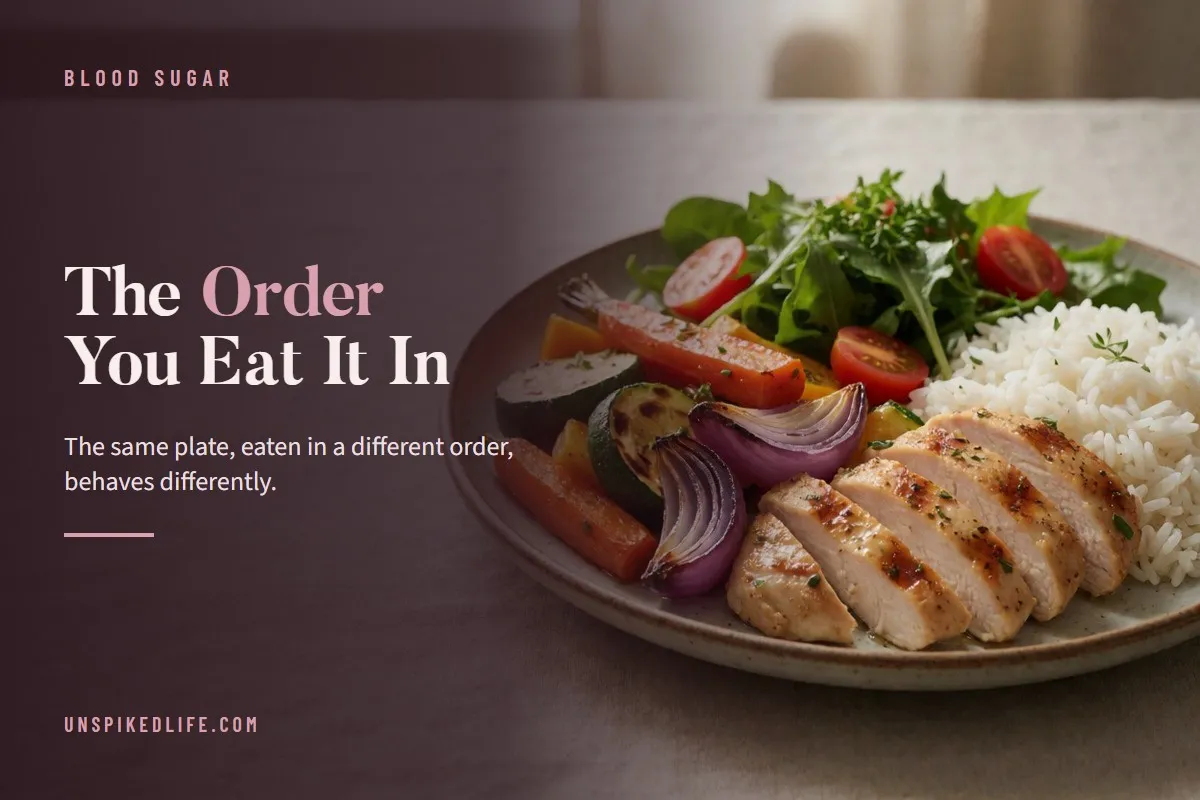
You have eaten the same lunch twice and had two different afternoons.
Same sandwich. Same little salad next to it, same coffee after. One day you work through until six without thinking about food. The other day it is ten past three, you are standing in front of the cupboard, and you are not really hungry so much as looking for something. You have probably decided that the second day was about willpower, or stress, or not sleeping well.
It might have been none of those. The same plate can behave two different ways depending on the order it goes in, and that is a smaller and more useful thing than it sounds.
Nothing below asks you to remove anything from your plate. There is nothing to buy, nothing to weigh, and you can try it at your next meal.
1. Protein first
Start the meal with the protein. The eggs, the chicken, the fish, the yoghurt, the cottage cheese, whatever the protein on that plate happens to be.
Protein slows how fast everything after it digests. That is the whole mechanism, and it is why this position comes first rather than anywhere else in the sequence. The rest of the meal now arrives into a stomach that is already working slowly.
You are not eating more protein than you were. You are eating it earlier.
2. Then the fibre
Next, the vegetables. The salad, the greens, the roast veg on the side, the coleslaw, the half a tomato nobody planned.
Fibre builds a barrier before the rest of the meal lands on it. Soluble fibre soaks up water and turns into a gel. Anything mixed into a gel moves more slowly than it would in liquid. So the vegetables are not there to fill you up before the good part. They change how the good part behaves.
One thing worth saying plainly: vegetables first instead of protein first is fine. Either opening works. What matters is that the starch is not first.
If a meal has no vegetables in it at all, chia or ground flaxseed will stand in. Both carry fibre and protein together, both cost very little, and both disappear into yoghurt, oatmeal or a sauce without announcing themselves. It is the cheapest upgrade available to almost any meal you already eat.
3. Then the fats
Now the fats. The olive oil already on the salad, the avocado, the butter on the vegetables, the cheese, the handful of nuts.
Fats slow the meal further, and they do it without changing what the meal is. This position tends to look after itself, because most fat on a plate is attached to something else. If you dressed the salad, you have already eaten in this order without trying.
4. Anything starchy or sweet, last
The bread. The rice, the pasta, the potatoes, the chips. The dessert.
None of it is being removed. It goes in at the end, when the meal is already moving slowly. That is a very different arrival from the same food landing on an empty stomach. Starch eaten first has nothing in front of it.
This is the position people expect to be told to give up. You are being told when to eat it.
The plate has not changed
Read the four positions back and notice what is missing from them. There is no food you have to stop eating. There is no shopping list. There is no version of this where you sit down to something different from what you actually wanted.
You are choosing the order, not the food. That is the point. A change you can make with the plate already in front of you is one you might still be making in March.
What it looks like at three real meals
Breakfast, if breakfast is toast. Eggs first. Then the toast, jam and all. If breakfast is oatmeal, eat a spoon of yoghurt or some seeds before you start on the bowl. A savoury start behaves differently from a sweet one. Breakfast also tends to set the pattern for the rest of the day, including what you want at nine in the evening.
At a restaurant. The bread basket arrives before anything else. That is exactly the wrong order, and it is not an accident. Leave it where it is until your food comes. Eat the protein and the salad off your plate first, then go back to the bread if you still want it. You will sometimes find you do not.
At someone else’s dinner table. You do not have to announce anything. No explaining, no turning down a dish, no making the meal into a topic. You eat what you are given, in an order that is entirely your own business.
If you eat plant-forward
Same sequence, different foods. The beans, peas or lentils go in the protein position, and everything after that is unchanged.
A tin of chickpeas, rinsed, opens a meal perfectly well. So do lentils, black beans, edamame, or tofu. Nothing about the order depends on eating meat.
The meal with no order at all
A smoothie is the one case where none of this applies, because everything went in at once and there is no sequence left to arrange.
That does not make it a bad breakfast. It makes the build matter more than usual. A smoothie that holds has protein in it, something green, berries rather than a lot of sweeter fruit, a source of fibre, and an unsweetened liquid. Without the protein and the fibre it is closer to fruit juice, and it behaves like fruit juice.
If your smoothie leaves you hungry 45 minutes later, you have your answer, and you did not need a device to get it.
The 45-minute check
Here is how to find out whether any of this is doing something for you, without a device, an app or a subscription.
Eat a meal in the order above. Then notice how you feel around 45 minutes to an hour later.
Full, steady and clear-headed is one answer. Hungry again, sleepy, foggy or looking for something sweet is a different answer. Both are information. Both are yours, rather than a number on a screen that somebody else has to explain to you.
Try the same meal in the old order later in the week and compare. That is a real test, run on the only body the result has to apply to.
Some people find one meal changes a lot and another barely changes at all. That is worth knowing too. The goal was never to force a food because it appeared on a list.
Start with one meal, not every meal
Pick lunch. Just lunch, for a week.
The instinct is to apply this to everything from tomorrow morning, and it is worth resisting for a reason that has nothing to do with discipline. Your body responds to the rate of change, not only its direction. Change five things at once and you feel worse for a few days while your body adjusts. You cannot tell which change did what. So you decide none of it worked. Change one thing, and there is only one thing it could have been.
There will be meals where the order goes out of the window entirely. Someone else cooked, or it was a birthday, or you were eating in the car. That is not a lapse and it does not need making up for. One meal has never been the thing that mattered here. The pattern is.
One meal, one week. Nothing left the plate.
This is general education about food and daily habits, not medical advice. Talk to your own clinician before changing anything, particularly if you take prescribed medication.