Doesn't Spike Doesn't Mean Fine
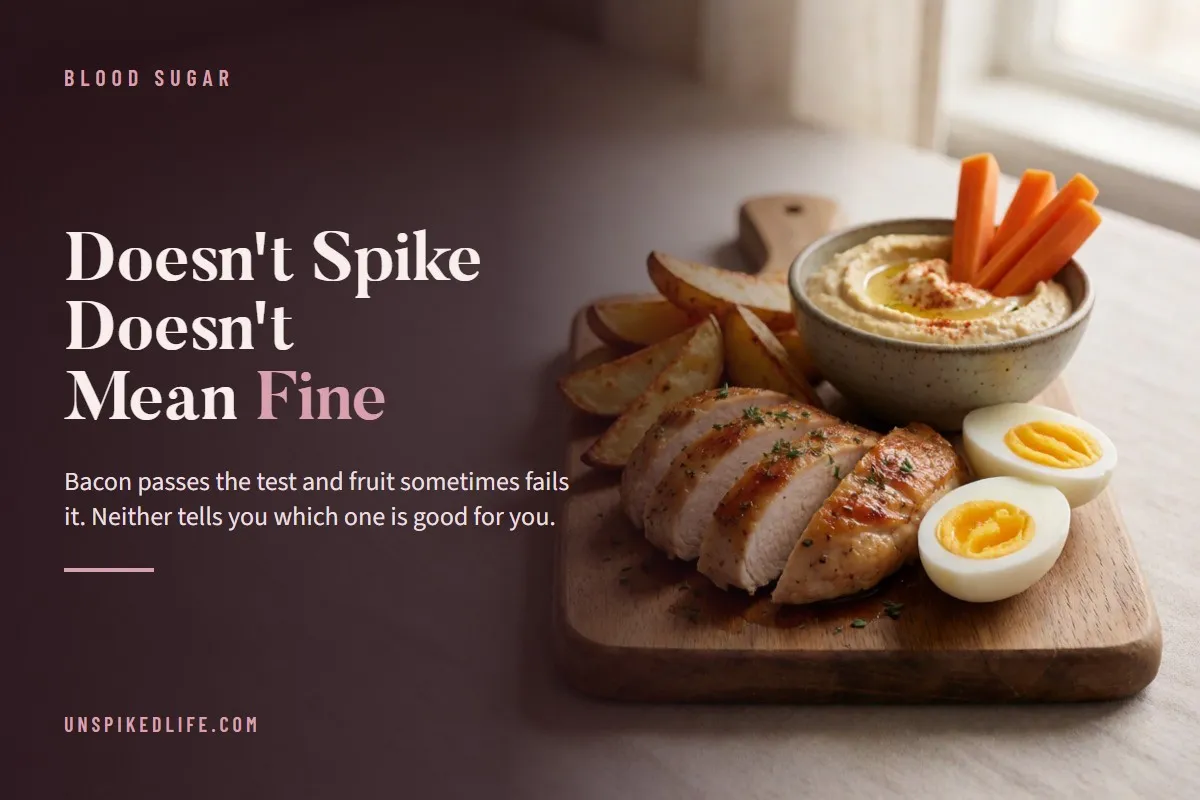
You cut the toast and kept the bacon. It made sense at the time.
Bacon has no sugar in it. It does not give you the rush and the crash that toast does. So you ate more of it, and more sausage, and a deli-meat wrap at lunch instead of a sandwich. All of it passed the test. None of it spiked.
And a few months on, you feel about the same. Maybe a bit worse.
The test was not wrong. It was just one test, and it only measures one thing.
1. The spike is one signal, not the whole picture
How fast a food raises your blood sugar is worth knowing. A lot of this site is about exactly that.
But it is a short-term signal. It tells you what happens in the next hour or two. It does not tell you what a food does when you eat it every day for a year.
Some foods barely move your blood sugar and still wear the system down slowly. Some foods raise it for a while and are still some of the best things you can eat. Whole fruit is the obvious example. It can raise your blood sugar after a meal, and eating it regularly is still linked with better health, not worse.
So “it didn’t spike me” and “it’s good for me” are two different sentences. Here are three foods where the gap between them is widest.
2. Processed meat
Bacon, sausages, ham, salami, hot dogs, sliced deli meat. The meat that has been smoked, salted or preserved to keep.
It passes the spike test easily. There is no sugar in it. That is why so many people lean on it when they start cutting carbohydrate.
The trouble is what comes with it. A lot of salt, a lot of saturated fat, and the chemicals used to preserve it. Eaten now and then, that is not a big deal. Eaten every day, it adds up to low-level inflammation in the body. And ongoing inflammation makes your cells respond less well to insulin, which is the hormone that moves sugar out of your blood.
So a daily processed-meat habit can make blood sugar harder to manage over time, even though it never spikes it on the day.
The swap: keep the protein, change the kind. Eggs, a tin of fish, leftover roast chicken, Greek yoghurt, a tin of chickpeas. All of them carry the protein and none of them carry the preservatives.
You do not need to give up bacon. Move it from every day to Saturday.
3. Fried food
Chips, fried chicken, anything battered or breaded and dropped into hot oil.
Fried food does two things at once. The coating is usually refined flour, which is fast-digesting starch. That part does raise your blood sugar. Then there is a lot of fat soaked up from the oil, which slows the rise down, so the spike looks smaller than you would expect.
That is why the spike test can go easy on fried food. The fat hides the starch.
But you are still getting both. The starch, plus a large dose of calories from the oil. The oil used for deep frying has often been heated again and again, too. Over months, that load pushes in the same direction as the processed meat.
The swap: the same food, cooked a different way.
Roast it in the oven with a spray of olive oil. Or use an air fryer, which gets the crunch with a spoon of oil instead of a pan full. Potato wedges with the skin on, a little oil, twenty minutes in a hot oven. You still get chips, and most of the frying is gone.
If you like a coating, use wholemeal breadcrumbs. You keep the crunch and add some fibre.
4. Packaged snacks
Crisps, pretzels, crackers, the snack bars in the lunchbox aisle.
These are mostly refined flour, oil and salt, made to be very easy to eat. Some of them spike blood sugar and some do not. Either way, they share the same problem. There is almost no protein or fibre in them.
Protein and fibre are what keep you full. Without them, a snack lasts about half an hour. Then you are hungry again, and you reach for the next one. That is not you being greedy. It is the snack being empty.
The swap: a snack that has protein or fibre in it, or both. Hummus with carrot sticks. Roasted chickpeas. A small handful of nuts with an apple. A boiled egg. Any of these will carry you to the next meal, and most cost less than the packet.
5. Why these three are so hard to put down
If you have tried to eat less of these foods and found it hard, that is worth saying plainly. They are made to be hard to stop.
Salt, fat and crunch, in the right mix, are about as appealing as food gets. Companies spend a lot of money getting that mix right. They put it on every shelf at eye level, and they price it low.
So finding it hard is not a sign you lack willpower. It is a sign the product works as designed. Knowing that makes it easier to stop blaming yourself and start changing what is in the cupboard.
6. What a week of swaps looks like
None of this needs a new diet. It needs the same meals, with the empty part taken out, and here is roughly what that looks like across an ordinary working week.
Monday, the lunchtime wrap gets leftover roast chicken instead of sliced ham. Tuesday, the four o’clock crisps become a small tub of hummus and a few carrot sticks. Wednesday, eggs at breakfast instead of the sausage. Thursday, the chips with dinner come out of the oven, not the fryer. Friday, fish on the plate, but baked with a crust of breadcrumbs and lemon rather than battered.
On Saturday, have the bacon. Enjoy it. The point was never to ban it.
By the end of that week you have eaten almost all the same kinds of meal. You have just moved the processed, fried and packaged versions from every day to now and then. Over a year, that is a very large difference, and it did not ask you to go hungry once.
7. The test works the other way round too
This is the part people miss.
Just as “no spike” does not mean fine, “some spike” does not mean bad.
Fruit, beans, lentils, oats and potatoes can all raise blood sugar a bit. Every one of them also brings fibre, and minerals, and food for your gut bacteria. The answer to those is almost never to cut them. It is to eat them with protein, eat them later in the meal, or pick the kind with more fibre. There is a whole article on the order you eat things in, and it matters more than most people think.
So when a food fails the spike test, ask a second question. What else does it bring?
And when a food passes, ask the same question. A food that brings nothing but salt and fat has passed a test that was never built to catch it. The only way to see that is to look at what it brings, not at what it avoids.
Start with one
Look at what you eat most days and find the one that passes the spike test by being empty. The deli ham in the lunchtime wrap. The bag of crisps at four. The fried chicken on Fridays.
Swap just that one, for the version in this article. Keep everything else the same.
Give it a week. Notice whether you are fuller for longer, and whether the four o’clock hunger is any smaller. That is information about your own body, and it is worth more than any single test.
This is general information about food and daily habits, not medical advice. Talk to your doctor before changing anything, especially if you take medication.
This is general education about food and daily habits, not medical advice. Talk to your own clinician before changing anything, particularly if you take prescribed medication.