Adding Is Not Swapping
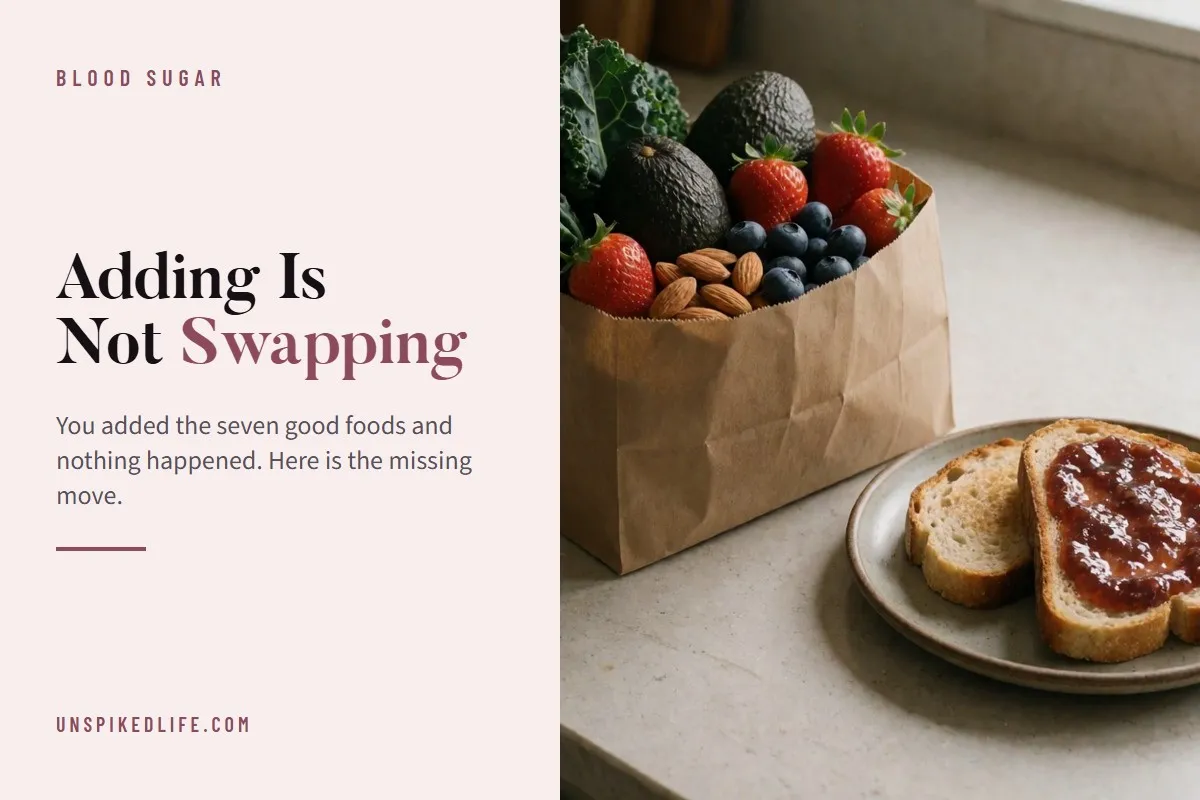
You read the list. You bought the seven things on it.
The salmon is in the freezer. There are lentils in the cupboard, chia seeds in a jar, a bag of frozen berries, a tub of plain yoghurt. You have been eating them for three weeks and you feel about the same. So you have started to think that either the list was rubbish or you are.
Neither. What happened is the most common failure of every list article ever written, including several on this site.
You added them. You did not swap anything.
1. The arithmetic nobody does
Say the old breakfast was toast and jam and a coffee.
Now you add the yoghurt, because yoghurt was on the list. You did not stop having the toast and jam, because nobody told you to and the list did not say to. So breakfast is now toast, jam, coffee and yoghurt.
The yoghurt is genuinely good. It has protein in it. But the toast and jam are still doing exactly what they were doing before, in the same order, at the same speed, on the same empty stomach.
You added something helpful to a pattern that has not moved. The pattern is what produced the eleven o’clock hunger, and the pattern is untouched.
Repeat that across seven foods and you have a more expensive week with the same afternoons in it.
2. Two kinds of adding, and only one of them works
Now the part that makes this confusing, because plenty of good advice does say to add things. This site says it often.
The difference is whether the addition changes the shape of a meal or just sits next to it.
Adding that works. Chia into the oatmeal you already eat. Eggs before the toast. Beans into the soup. A second vegetable next to the first. In every one of those, the new thing changes how the rest of the meal behaves. The seeds gel and slow it. The eggs go in first and slow what follows. The starch now arrives into a stomach already working slowly.
Adding that does nothing. A salmon fillet on Tuesday, in a week otherwise unchanged. A handful of nuts on top of everything else you were already eating. Berries in a bowl at nine in the evening, after dinner, as a well-intentioned extra.
The first kind is a swap wearing a friendlier word. The second is a purchase.
3. The right foods in the wrong order
The second way a good list fails is order, and it costs nothing to fix.
You can eat all seven foods on the list, starch first, fast, on an empty stomach. You will get less out of them than the woman who ate three of them in a different order.
Protein first. Then the fibre. Then the fats. Then anything starchy or sweet, last. Same food, same plate, same shopping. The last thing in arrives into a meal that is already moving slowly, which is a very different event from the same food landing on nothing.
Nobody puts this at the top of a food list because it does not sell anything.
4. Healthy does not mean unlimited
The third failure is portion, and it is the one people are most reluctant to hear.
A food being good for you is not a statement about quantity. Nuts are excellent and easy to eat half a bag of. Dried fruit is fruit and is also sugar with the water taken out. Olive oil is a fat worth having and is still a fat.
The signal worth using is not full. It is no longer hungry, which arrives earlier and is easy to eat straight past. Fullness turns up some minutes after the point where you could comfortably have stopped.
Pistachios in the shell are a good trick here, and the mechanism is honest. Cracking each one slows you down enough for the signal to land before the bowl is empty.
5. What a swap actually looks like
A swap has three parts, and most people do the first one only.
Something comes out. Not out of your life. Out of that particular slot, on that particular day.
Something goes in where it was. The same meal, the same time, the same job on the plate.
The old thing is still allowed. Later, elsewhere, on a Friday. This is not a banned list, and a banned list is what produces the collapse on day twelve.
The juice at breakfast becomes whole frozen berries. The snack bar at four becomes a boiled egg. The flavoured yoghurt becomes plain yoghurt with your own fruit in it. The rice at dinner becomes half rice and half something else, and the ratio moves over a few weeks rather than in one evening.
That last one is the best behavioural idea in this whole subject. Do not replace the pasta. Mix the courgette into it, and shift the proportion slowly, and nobody at the table has to have an opinion about it.
6. Why lists are written this way
None of this is a conspiracy, and it helps to know why the failure is so common.
A list of seven foods is easy to write, easy to read and easy to share. A swap is harder on every count, because a swap needs to know what you were already eating. Nobody writing a list knows that.
So the writer names the good thing and leaves the rest to you. Which would be fine if anybody had ever told you that the rest was the hard part.
It also sells better. Seven foods sends you shopping. One swap sends you to your own kitchen, where there is nothing to buy.
You can still use the lists. Read them as a menu of candidates rather than as instructions, and do the swapping part yourself.
7. Three questions before you add anything
Next time a list gives you seven foods, ask these before you spend anything.
Which meal is this going into? If the answer is “somewhere”, it is going nowhere.
What is it going in instead of, or in front of? If the answer is “nothing”, you are adding, not swapping.
Is it still there in March? A food you do not like, cooked in a way you resent, is a purchase with an expiry date on it.
Three questions, about thirty seconds. They will cut most lists from seven items down to two, which is roughly the right number anyway.
8. Where adding genuinely is the whole move
To be fair to adding, there is a case where it is exactly right. Worth naming, so this does not read as a rule against it.
Fibre variety is additive. Eating a wider range of plants across a week is a genuine change on its own, because different microbes handle different fibres and the range is the point.
Protein is often additive too. Most women in this stretch of life eat less of it than they think, and it displaces nothing when it goes in first.
Water is additive. Ten minutes of walking after a meal is additive.
What those have in common is that each one changes how something already on the plate behaves. That is the test. Not whether the thing is added or removed, but whether the meal is different afterwards.
Start with one slot
Pick one meal on one day, and make one swap in it.
Not seven foods. One slot. The four o’clock thing, or the breakfast, or the drink with lunch. Whichever one you already know is the weak point.
Keep it for a fortnight and ask the question that settles it. Forty-five minutes to an hour after that meal, are you full and steady, or are you thinking about the kitchen?
Then, and only then, do the next one.
Seven good foods in an unchanged week is a shopping list. One thing in a different place is a change.
This is general information about food and daily habits, not medical advice. Talk to your doctor before changing anything, especially if you take medication.
This is general education about food and daily habits, not medical advice. Talk to your own clinician before changing anything, particularly if you take prescribed medication.