It Was Never Willpower
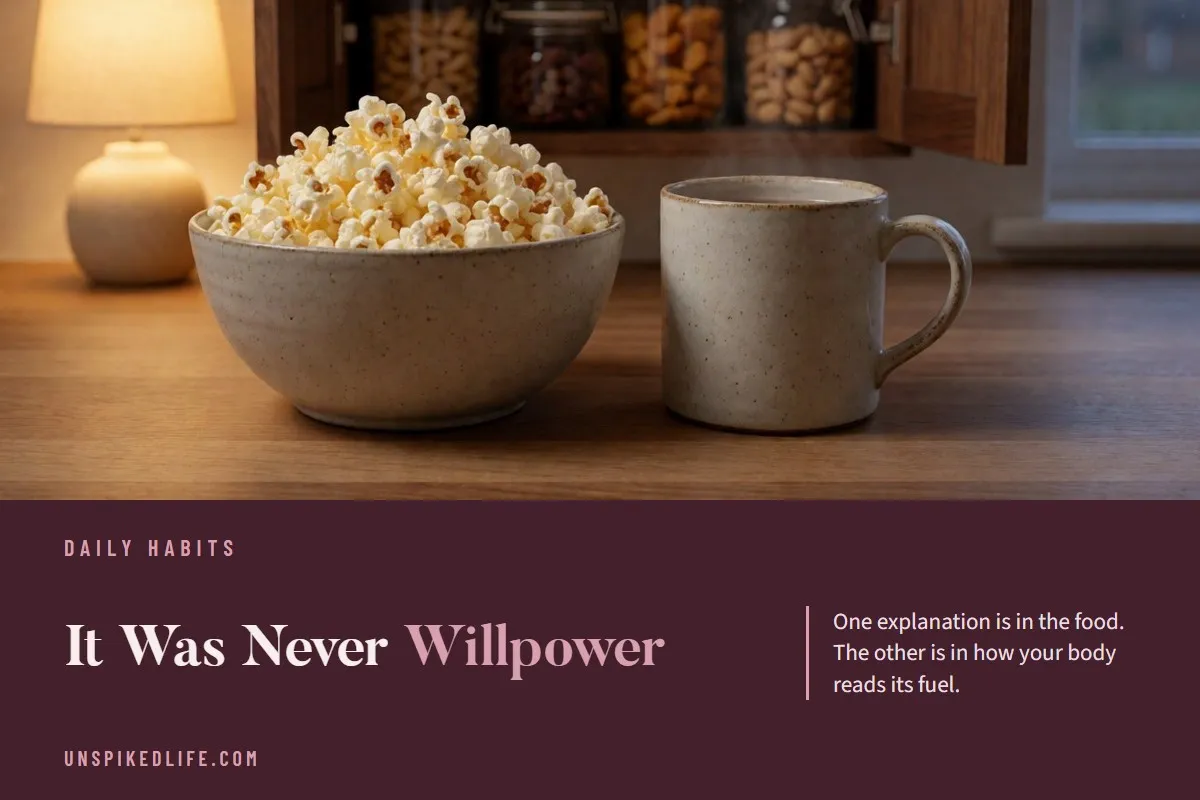
You meant to have three.
The bag was open on the sofa and the programme was on. Somewhere around the middle of it you looked down, and most of the bag was gone. You were not upset. You were not celebrating anything. You were just eating, and then you had finished, and then you felt the small flat drop that always comes after.
You have had a version of that evening for twenty years. You have also had every possible explanation for it, and all of them were about you. Not enough discipline. No self-control. A bad relationship with food.
There are two other explanations, and they have nothing to do with your character. One of them is in the food. The other is in how your body is reading its fuel supply that evening. They are separate, they are both real, and together they account for most of what you have been blaming yourself for.
1. Fullness is partly a volume signal
Start with something simple, because it is easy to miss.
Your stomach reports on how much is in it. Stretch is part of how you know to stop. It is not the only signal, but it is a fast one and it works without you thinking about it.
Fibre acts like a sponge. It holds water, takes up room, and slows everything moving through. A bowl of lentil soup and a chocolate bar can carry a similar amount of energy, and only one of them tells your stomach that anything has arrived.
So a food can be perfectly pleasant, go down easily, and never once send the signal that would have stopped you. You did not override the signal. It did not come.
2. Some foods are built so the signal never arrives
Now the part that is not an accident.
A great deal of money and a great deal of testing goes into food that is easy to keep eating. The fat and the sugar and the salt are balanced against each other. The crunch gives way at exactly the right pressure. There is almost no fibre and very little to chew, so it clears your mouth fast and leaves room for the next one.
Every one of those choices removes a brake. Nothing about it is a mistake. It is the product working.
Sit down with a bag of crisps and a bag of roasted chickpeas and watch what happens. Same salt, same crunch, same hand-to-mouth rhythm. You will stop with the chickpeas. Fibre, protein and something to actually chew put the brakes back on, and you did not have to try.
This is worth saying plainly because of what it means about the last twenty years. You were not weak in front of the biscuits. You were up against something designed to be difficult to stop eating, and it was doing its job.
3. The other mechanism, which is about fuel
The second explanation runs underneath the first, and it is why cravings can feel physical rather than mental.
Here is the picture. Your cells are not taking up fuel as easily as they used to. There is plenty in the bloodstream, but less of it is getting where it needs to go.
Imagine a fridge full of food with the door locked. Stand in front of it and you can see everything on the shelves. You cannot get to any of it. Your brain has one instruction for a situation like that, and it is not a subtle one. Eat something. Now.
That is what an urgent craving is. Not a mood, not a weakness. A shortage signal, sent by a brain that is going by what it can reach rather than by what is there.
You can tell the difference by how it feels. Ordinary hunger builds slowly and is happy with most foods. This other thing arrives suddenly, wants something specific, and does not want to negotiate.
4. Why the relief runs out so fast
Give that signal what it asks for and something better happens for about half an hour.
The relief is genuine. Fuel arrives quickly, the brain gets what it wanted, and for a little while you feel more like yourself.
Then it fades, and often you land lower than you started, and the same instruction comes back louder. Which is how an evening turns into four separate trips to the kitchen, none of which you planned.
Thirty minutes is not long enough to be a solution. It is long enough to be a habit.
5. What actually changes it
If both mechanisms are real, then both have an answer, and neither answer is trying harder.
Put the brake back into the food. Fibre plus protein or fat, at the same time. Berries with almond butter. A hard-boiled egg with half an avocado. Raw vegetables with hummus. Popcorn you popped yourself, with a spoon of nutritional yeast over it for the savoury, almost cheesy edge that answers a salt craving. Two squares of dark chocolate at seventy per cent, which genuinely satisfies in a way the sweeter versions do not.
Swap the vehicle, not the dip. You do not have to give up the hummus. Cucumber spears carry it perfectly well. This is the whole idea in one move, and it asks you to give up nothing.
Season it like the food you already cook. Roasted chickpeas with garam masala, or za’atar, or smoked paprika, depending on whose kitchen you grew up in. Food that tastes like your food is food you will make again in March. Diet food is not.
Eat enough earlier. A great many nine o’clock cravings were built at one o’clock by a lunch that was too small. Nothing you do in the evening will fix an evening that was set up at lunchtime.
Decide in advance when a long gap is coming. Dinner at eight, work finished at six. Choose the four o’clock thing while you are calm, not while you are standing in front of the cupboard.
6. Meals are the main event
One honest note, because this could easily read as encouragement to eat all day.
It is not. Grazing from morning to night keeps the whole system busy and never lets anything settle, and most people do better with proper meals and clear space between them.
The list above is for the real gaps. The afternoon that runs long. The evening when dinner slips. The day that got away from you. Those days exist, and pretending they do not is how people end up with nothing planned and a bag of something open on the sofa.
7. What to stop doing
Stop scoring foods as good and bad.
The scoring is what precedes the collapse. A food gets moved onto the forbidden list. You hold the line for eleven days. On the twelfth the whole structure comes down at once, and it takes far more with it than the food ever would have. Then the collapse becomes the new evidence that you cannot be trusted, and the next round of rules is stricter than the last.
Nothing about that cycle is a fact about you. It is a fact about how restriction works in every human being who has ever been studied doing it.
Start with one thing
Pick the afternoon. Just the afternoon, for one week.
Choose what you will reach for before you need it, and make it something with fibre and protein or fat in the same handful. That is it. Do not also change breakfast, and do not put anything on a banned list.
Your body responds to the rate of change, not only the direction. Change six things at once and it feels harder than it should, you cannot tell which change did what, and you conclude the whole idea was wrong. Change one and there is only one thing it could have been.
There will be evenings when the bag is open anyway. That is not a lapse and it does not need paying for on Tuesday. One evening was never what mattered here.
And whatever you decide to do about any of it, you can put down the part where this was a flaw in you. It was not. It never was.
This is general information about food and daily habits, not medical advice. Talk to your doctor before changing anything, especially if you take medication.
This is general education about food and daily habits, not medical advice. Talk to your own clinician before changing anything, particularly if you take prescribed medication.