The Fruit Bowl, Ranked For Steady Energy
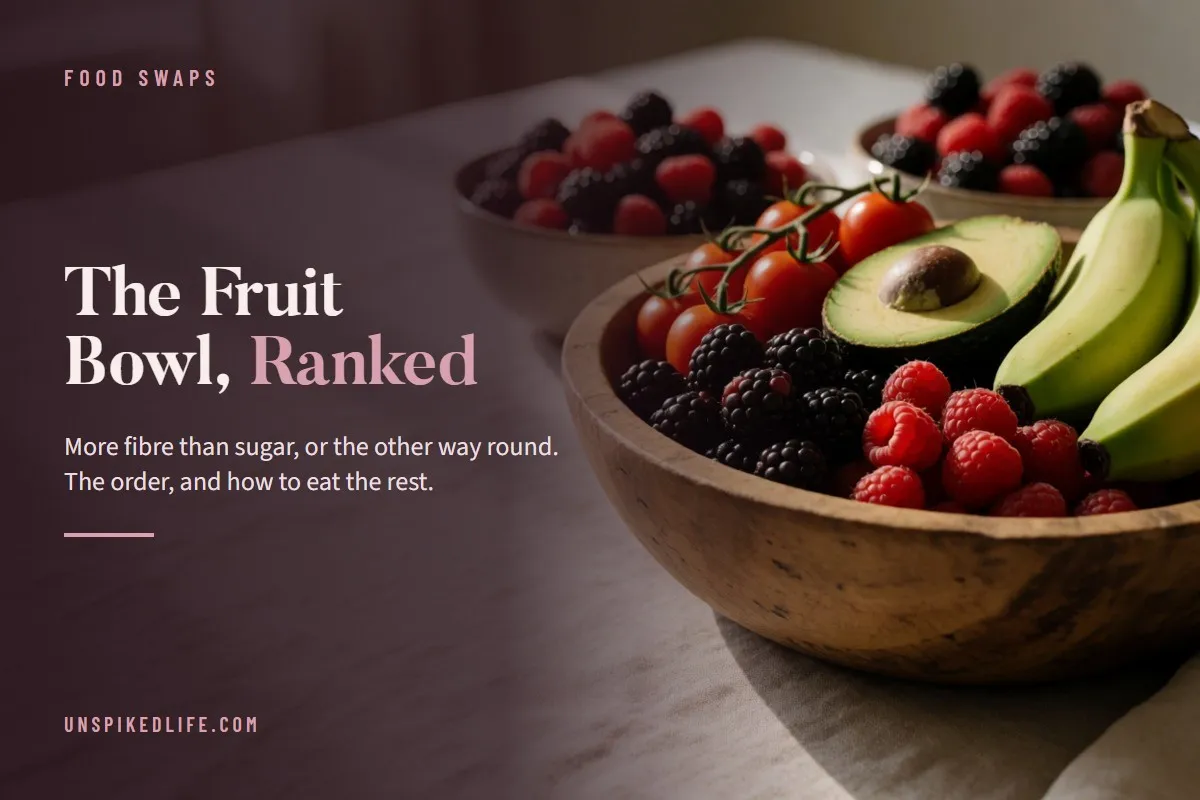
A banana at eleven, because it is the healthy choice. By twelve you are hungrier than before you ate it.
Then one day it is raspberries instead. Same time, same desk. Somehow they last until lunch.
You did not imagine that. Fruit is good for you, and none of what follows says otherwise. But fruit is not one food. Each piece carries some sugar and some fibre, and the balance between the two decides how it lands.
More fibre, less sugar, and it lands softly. The other way round, and it lands fast and leaves fast.
1. Berries are not one food
Most lists put all the berries in one row. They should not.
Blackberries are at the top. A cup has more fibre than it has usable sugar. That is rare for anything sweet.
Raspberries are right behind. The same fibre, a touch more sugar.
Strawberries are fine. They have about the same sugar as raspberries and less than half the fibre.
Blueberries are the surprise. A cup carries about three times the sugar of a cup of blackberries, and half the fibre. They are still a good food. They just behave more like an apple than like a raspberry.
So if you buy one bag of berries a week, buy the blackberries. They are often cheaper frozen, and frozen fruit is picked ripe and frozen the same day. Nothing is lost.
2. The fruit nobody counts
Three of the steadiest fruits in the shop do not get called fruit at all.
Avocado. It is very high in fibre and very low in sugar. It is high in fat too, and that fat slows everything else on the plate.
Olives. A cup of olives carries about the sugar of a cup of strawberries, plus a lot more fat. The fat is doing the same job as the avocado’s.
Tomatoes. Low sugar, a fair bit of fibre, and on the plate for most of the year anyway.
None of these will stand in for a sweet craving. But they count, and they are the easiest fruit to eat every day.
3. The ones to portion, not drop
A few fruits carry a lot of sugar and very little fibre. They are not banned. They just want a smaller bowl and some company.
Bananas. A medium one has a lot more sugar than fibre. Half a banana with a spoon of peanut butter is a different snack from a whole one on its own.
Pineapple. A lot of sugar, not much fibre. A few pieces, not the tin.
Grapes. Higher in sugar than most people guess, with almost no fibre. A small handful goes further next to some cheese.
Watermelon. A cup of it is mostly water and is fine. The trouble is the portion. Nobody eats one cup of watermelon. The third cup is the one that counts.
4. The green banana trick
This one is simple and it works.
As a banana ripens, its starch turns into sugar. That is why a ripe one tastes so sweet. A green, firm banana, the kind that is hard to peel, has much less sugar and more of the starch that digests slowly.
You will not want to eat it on its own. But in a smoothie you get the texture and the fibre without most of the sugar. Buy them green, and use them before they spot.
5. Juice is not fruit
Juice is fruit with the fibre taken out.
The fibre is what slowed the sugar down. Take it away and what is left goes straight in. It does not matter if it is fresh-squeezed and it does not matter if it is organic. It is closer to a can of fizzy drink than it is to an orange.
The fix is not to drink less orange. It is to eat the orange.
A whole orange takes a few minutes to eat, and the fibre comes along with every bite. A glass of juice holds the sugar of three or four oranges, and it goes down in about ten seconds. Nobody eats four oranges in a row.
6. Dried fruit is a smaller portion than it looks
Dried fruit is the same fruit with the water taken out. The sugar is all still there, packed into a quarter of the space.
So a small box of raisins is a lot of grapes. A few dates are a lot of sugar. And some dried fruit has sugar added on top, which the front of the packet will not mention. The ingredients list will.
A few pieces with a handful of nuts is a fair snack. The whole bag on its own is not.
7. Give fruit some company
Here is the easiest way to make any fruit steadier. Do not eat it alone.
Protein and fat slow how fast the rest of a snack digests. So the apple with a slice of cheese behaves better than the apple alone. The blueberries go further stirred into plain yoghurt. Half a banana with a spoon of nut butter lasts longer than a whole one with nothing.
You are not taking anything away. You are adding one thing next to it.
8. Eat it last
If the fruit is part of a meal, eat it at the end.
Protein first, then vegetables, then anything starchy or sweet last. The food that went down first slows everything behind it. That is true for bread and rice, and it is just as true for fruit.
Fruit after dinner is not a mistake. Fruit on an empty stomach at eleven is the one that leaves you hungry at twelve.
9. A week of fruit, done this way
None of this needs a new shopping list. It needs the same fruit, bought and eaten a little differently, and here is roughly what that looks like across an ordinary week.
Monday, the breakfast yoghurt gets a handful of frozen blackberries instead of blueberries. Tuesday, the apple comes with a slice of cheese. Wednesday, half an avocado goes on the toast. Thursday, the banana in the smoothie is a green one. Friday, the grapes come out after dinner rather than at four in the afternoon, a small bowl next to a few nuts.
The weekend is when the watermelon comes out. Cut one cup into a bowl and put the rest away before you sit down.
That is it. There is nothing on that list you could not buy this week, and nothing on it you have to give up. It is the same fruit bowl. It just lands more softly.
What this does not mean
It does not mean fruit is the problem. It is not. Fruit brings fibre, water and a lot of useful compounds with it, and eating more whole fruit is a good idea for most people.
It means the kind of fruit matters, and so does what you eat it with. That is all.
If you have been told to watch what you eat for a medical reason, check with your doctor before you change anything. This is not a plan made for you.
Start with one
Pick one swap this week.
Blackberries or raspberries instead of blueberries in the morning bowl. Or the banana cut in half, with a spoon of peanut butter. Or the orange instead of the glass of orange juice.
Then pay attention around an hour after. Still full and steady is one answer. Hungry and a bit flat is another. Both are worth knowing, and both are yours.
If the first swap is still happening on day seven, pick the next one.
This is general information about food and daily habits, not medical advice. Talk to your doctor before changing anything, especially if you take medication.
This is general education about food and daily habits, not medical advice. Talk to your own clinician before changing anything, particularly if you take prescribed medication.