Seven Foods That Keep Blood Sugar Steady
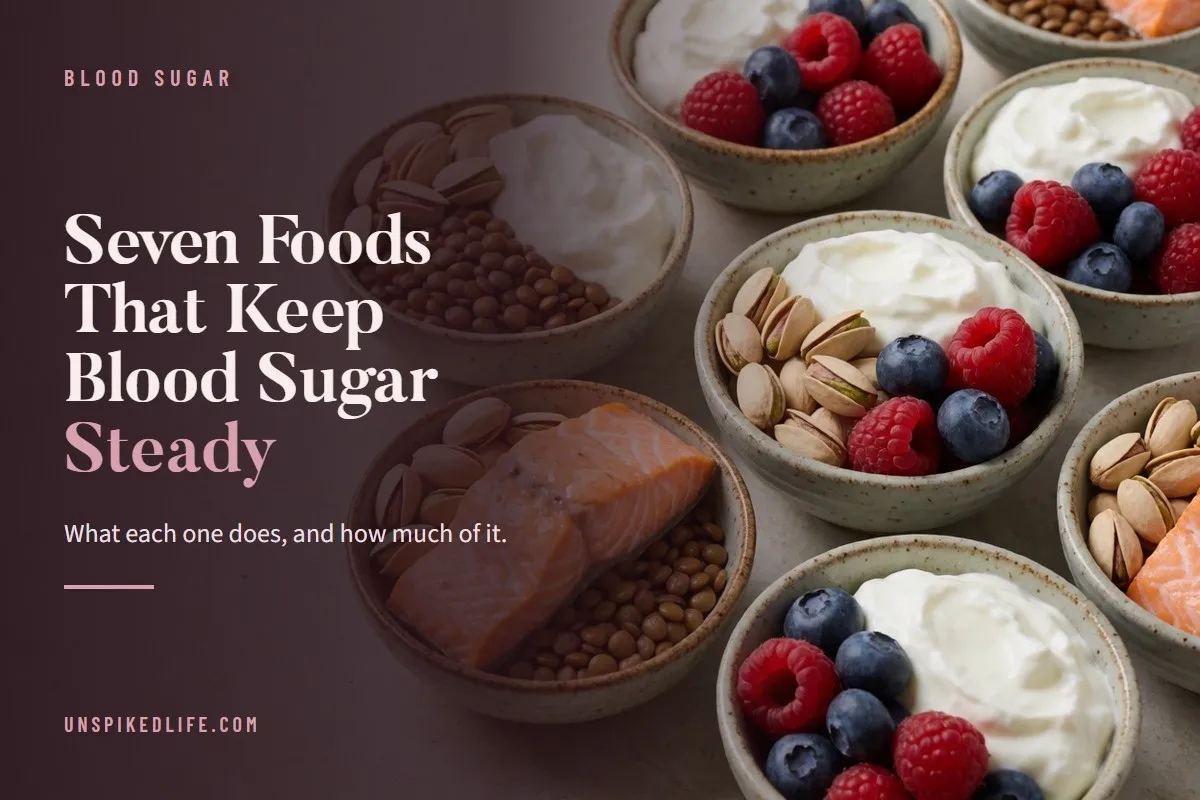
It is ten past three and you are standing at the cupboard again.
You had lunch. It was a perfectly reasonable lunch. And here you are two and a half hours later, not really hungry so much as looking, and slightly annoyed with yourself about it.
Lists like this one usually arrive with a tone of voice you did not ask for. So here is the plain version instead: seven foods, what each one does, roughly how much, and one practical note about buying or cooking it.
There is one idea underneath all seven, and it is worth having before the list.
Nothing here digests fast. That is the whole through-line. Protein, fat and fibre each slow how quickly a meal arrives in your blood, and every food below carries at least two of the three. They are not special foods. They are slow ones.
1. Salmon
A small piece of salmon leaves you full in a way that a larger piece of something else does not.
Protein and fat together slow how fast a meal digests, which gives the signal that you have eaten time to actually arrive. Most of us finish the plate before that signal lands. Salmon makes the plate smaller without you deciding to.
A 4oz serving covers a day’s worth of omega-3 on its own. That is a small piece, about the size of a deck of cards, and it is a whole day of one of the harder things to get.
Practical: wild carries more nutrients per calorie than farmed, but tinned salmon is real salmon and costs a third as much. A tin on toast at 1pm is not a lesser version of this.
2. Lentils
If you only take one food off this list, take this one.
Lentils carry resistant starch, fibre and protein in the same bite. Those are three separate things that each slow digestion on their own, arriving together. Very few foods do that, and almost none of them cost this little.
Practical: cook one big pan on a Sunday and scoop from it all week. Lentils fail for one reason, which is that nobody wants to start a forty-minute job at half six on a Tuesday. Cook them when it is not a Tuesday.
Colour tells you the time. Yellow and orange lentils go soft in about fifteen minutes and collapse into soups. Green, grey and black hold their shape and take longer. Most first attempts go wrong because somebody bought green and cooked them like red.
3. Broccoli
Broccoli’s fibre and resistant starch mostly are not for you. They feed the bacteria in your gut, which is one step removed from blood sugar and matters more than it sounds.
Those bacteria ferment that fibre into compounds that improve how your body handles the next few hours. It is slower and less direct than the other six, and it builds. You will not feel broccoli the way you feel a proper lunch. Six weeks of it is a different question.
Practical: frozen broccoli is picked at its peak and frozen the same day. It is not the compromise version. It is often the better one, and it is in your freezer at seven o’clock when fresh broccoli is a shop you did not go to.
4. Pistachios
Pistachios are protein, fat and fibre, in a form you eat with your hands in front of the television.
The useful thing about them is not nutritional. Buy them in the shell. Cracking each one takes a second or two. Those seconds slow the whole business down, and you notice you have had enough while there are still some left. Shelled pistachios are a bowl that empties.
Practical: a small handful, and buy the ones that still need work.
5. Chickpeas
Chickpeas do two things to appetite at once.
The fibre slows digestion. The protein raises your body’s own appetite-reducing hormones, which are the signals that tell you to stop. So there is a physical effect and a hormonal one, in the same tin.
Practical: a tin, rinsed, is thirty seconds of work. Rinsing matters because it takes the tinny liquid off and makes them taste like food. Into a salad, roasted with paprika, or mashed with olive oil and lemon onto toast.
Chickpeas at lunch also do something for dinner, which is a longer story and has its own article.
6. Berries
Berries are the answer to wanting something sweet that does not undo the meal.
They carry soluble fibre and the pigment compounds that make them those colours, with very little sugar load compared to most fruit. The fibre is the point, which is also why berries and berry juice are not the same food.
Practical: frozen, again. A bag of frozen berries costs a fraction of fresh and does not go furry at the back of the fridge on day three. Into yoghurt straight from the freezer.
7. Olives
Olives are mostly fat, and mostly the monounsaturated kind, with no sugar at all.
They are useful in the gap where you want something salty at six o’clock while you are cooking, which is the moment most days come apart. Six olives is a real answer to that moment, and it is a better one than the thing you would otherwise pick up while the pan heats.
Practical: the brine is the variable, not the olive. If salt matters to you, rinse them or read the jar, because the range between brands is wide.
Full is the wrong signal
This deserves its own heading, because it undoes more meals than any of the foods above fix.
The signal to stop is “I am not hungry any more”. It is not “I am full”. Those are two different points, and there is a good ten minutes between them.
Fullness is what arrives after the point where eating could have stopped. If you wait to feel full, you have already eaten past it, every time, no matter how good the food was. It is not greed and it is not a lack of discipline. It is a delay in the signal.
Try noticing the earlier one for a week. That is all. You do not have to act on it yet.
Noticing comes first because the point moves. It moves with sleep, with stress, and with what else was on the plate. A rule about portions cannot follow that. Attention can.
Start with one
Do not buy all seven.
Pick the one you would eat this week anyway, and add it to a meal you already make. Lentils if you cook. Tinned salmon if you do not. Frozen berries if the answer is neither.
One food, two weeks, and then decide whether to add another. One change at a time is not a gentle way of doing this. It is the way it lasts, and the reason is partly that keeping track of five new things is its own job, and that job runs out.
One warning, because it is the standard way a list like this goes wrong: adding is not swapping. Seven good foods placed on top of an unchanged week changes very little. The point is that the lentils are there instead of something faster, not as well as it.
This article is education, not medical advice. Nothing here is an assessment of you or your health. Talk to your doctor before changing anything, especially if you take any medication.
This is general education about food and daily habits, not medical advice. Talk to your own clinician before changing anything, particularly if you take prescribed medication.