Not All Protein Counts The Same
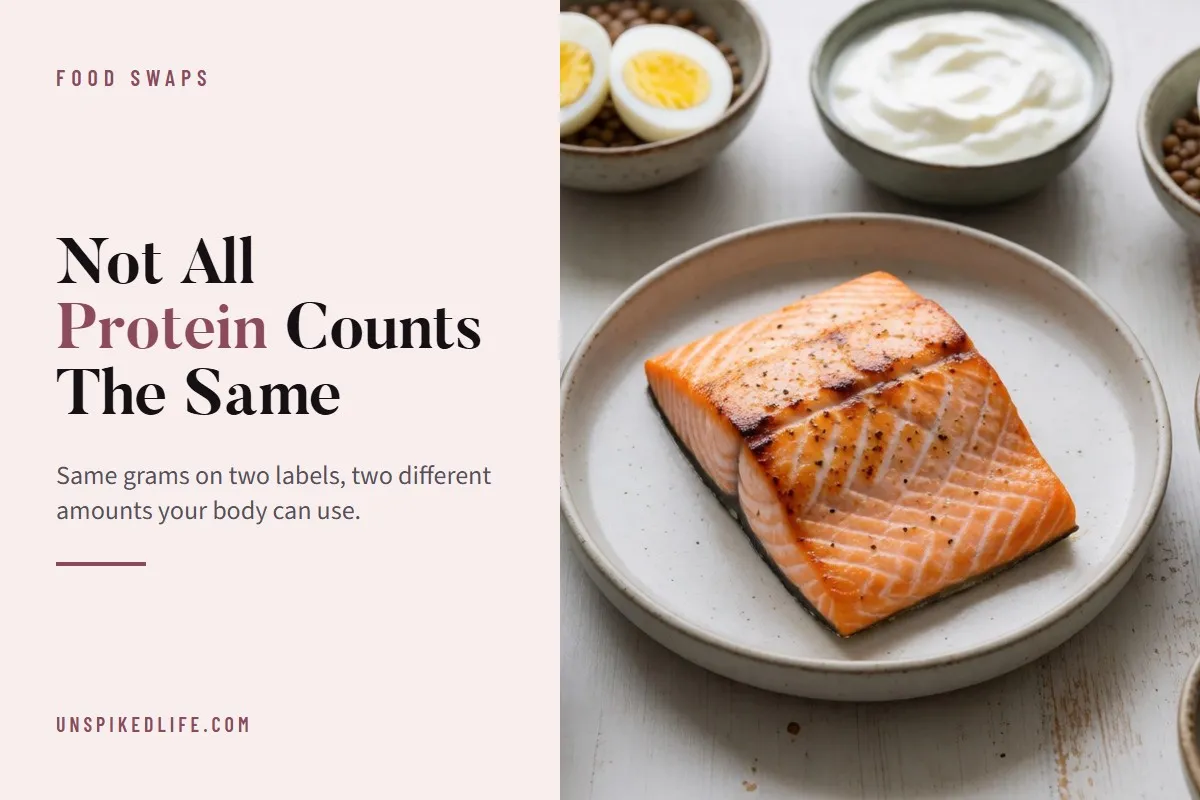
You have been getting more protein for months, and it has not made the difference you were promised.
You added the yoghurt. You put beans in things. There is a bag of lentils and you use it. The label on the porridge says twelve grams, and you have wondered what twelve grams of anything really means, since nothing in your afternoons feels different.
There is a piece missing from most protein advice, and this is it. The grams on the label are what went into your mouth. They are not what your body can use. The gap between those two numbers is large, it is different for different foods, and nobody mentions it.
1. What the gap actually is
Protein arrives, gets broken down, gets absorbed, and then gets used to build things. Losses happen at every one of those steps, and how big the losses are depends on the food.
There is a measure for this. It scores a protein on how much of it is digested, absorbed and usable, rather than on how much of it there was.
Eggs, fish, beef and dairy score at or near the top. Roughly all of what the label says arrives.
Beans, lentils and grains score a good way below. Roughly half to three-quarters, depending on the food.
That is the whole of the science part. There is no moral content in it. A lentil is not letting you down. It is a food where more of the protein stays behind, and it is also carrying fibre, resistant starch and minerals that the egg is not. Nothing here says eat fewer lentils.
2. What this means in a normal week
If you eat plant-forward, you need more volume to land the same usable protein. Not a different diet. More of it.
Which is annoying, because plant protein comes attached to a lot of fibre, and fibre fills you up. So you get full before you get there. That is not a failure of will, it is arithmetic about stomach space, and it explains why the beans-and-lentils week never quite delivered what it should have.
Practically, it means the person eating mostly plants who wants a real breakfast has to plan for it rather than assume it. The porridge with twelve on the label is not a high-protein breakfast, whatever the box says.
It also explains a specific frustration. Two people eat what looks like the same amount of protein, and one of them is hungry at eleven and the other is not. Same label, different arrival.
3. Closing the gap without abandoning how you eat
Nobody here is telling you to eat differently on principle. Three moves, in order of how little they cost.
Anchor one meal with a top-scoring source. One egg-, fish- or dairy-based meal a day does most of the work. That is two eggs at breakfast, or Greek yoghurt, or a tin of sardines on toast at one o’clock. Everything else stays as it is.
Combine at the same meal. Beans with grains, hummus with pitta, lentils with rice. The gaps in one are partly covered by the other, which is why these pairings exist in every cuisine that ever had to feed people cheaply.
Add soy where it fits. Tofu, tempeh and edamame sit noticeably higher than beans and lentils. Half a cup of edamame is about eleven grams of protein and four of fibre. It takes four minutes from frozen, and it is the cheapest fix on this page.
If you eat animal foods already, this whole section is one line: put the eggs, fish or dairy in first and stop worrying about it.
4. The number to actually aim at
About 25 to 30 grams at breakfast is the target worth having.
Breakfast, specifically, because most breakfasts are almost entirely carbohydrate and it is the meal where the gap is widest. Toast, cereal, a banana, a coffee. Perfectly nice, and there is close to nothing in it that lasts until eleven.
Protein at breakfast slows how fast the meal digests, which flattens the rise, and it also improves how you handle lunch several hours later. That is one meal doing something for a meal you have not eaten yet.
Two eggs is about twelve. Greek yoghurt is about fifteen to twenty for a decent bowl. Neither reaches thirty alone, and both get there with the other or with a couple of tablespoons of seeds.
Cottage cheese is the quiet winner if you can stand it. A small tub is close to the whole target on its own, and it costs less than most of the things marketed at you for this exact job.
5. The counting problem underneath all this
Here is why this has probably been happening to you invisibly.
If you count calories, protein is the thing the arithmetic punishes. Protein foods are calorie-dense, so every time you look for something to cut, protein is what looks expensive. The chicken goes, the salad stays, and the numbers improve while the meal gets worse.
Two hundred calories of chicken and two hundred calories of bread do not behave the same way in your body. Different fullness, different hormone response, different outcome. The calorie is a real unit that is blind to all of it.
The alternative is unglamorous: eat the protein first, and let fullness decide the amount. That works because protein is the thing you cannot easily overeat. It fills you up first. It is the only food group where the natural stopping point is more or less in the right place.
Try eating four chicken breasts. You cannot, and you do not need a rule to stop you. Now try four slices of white toast, which is a smaller amount of food and takes ninety seconds.
6. While you are reading labels
Two other things on the packet are worth knowing, because they come from the same place as the protein number.
Fibre that grew in the food is not the same as fibre added at the factory. Fibre in an oat or a bean slows the meal because of how it is built into the food. Isolated fibre stirred into a bar afterwards does not reliably do that, and the label counts them identically.
“Net carbs” is a marketing phrase. It works by subtracting things the manufacturer argues do not count. What is usually true is that the rise gets delayed rather than avoided.
Neither of these makes a bar a bad thing to eat. They make it a snack, rather than the health decision it was sold as. Eat the bar because you want the bar, at four o’clock, on a day that got away from you.
Start with one
Put 25 to 30 grams of protein into tomorrow’s breakfast, and change nothing else.
Two eggs and yoghurt. Yoghurt and two tablespoons of seeds. Tofu scrambled with whatever you would have had anyway. Sardines on the sprouted toast if you are that sort of person, and some people are.
Give it two weeks and pay attention to eleven o’clock rather than to the scale. Eleven o’clock is where you will notice it first, and the scale is the last thing in the queue.
One change at a time. This one is a big enough change on its own.
This article is education, not medical advice. Nothing here is an assessment of you or your health. Talk to your doctor before changing anything, especially if you take any medication.
This is general education about food and daily habits, not medical advice. Talk to your own clinician before changing anything, particularly if you take prescribed medication.