Why Prunes Actually Work
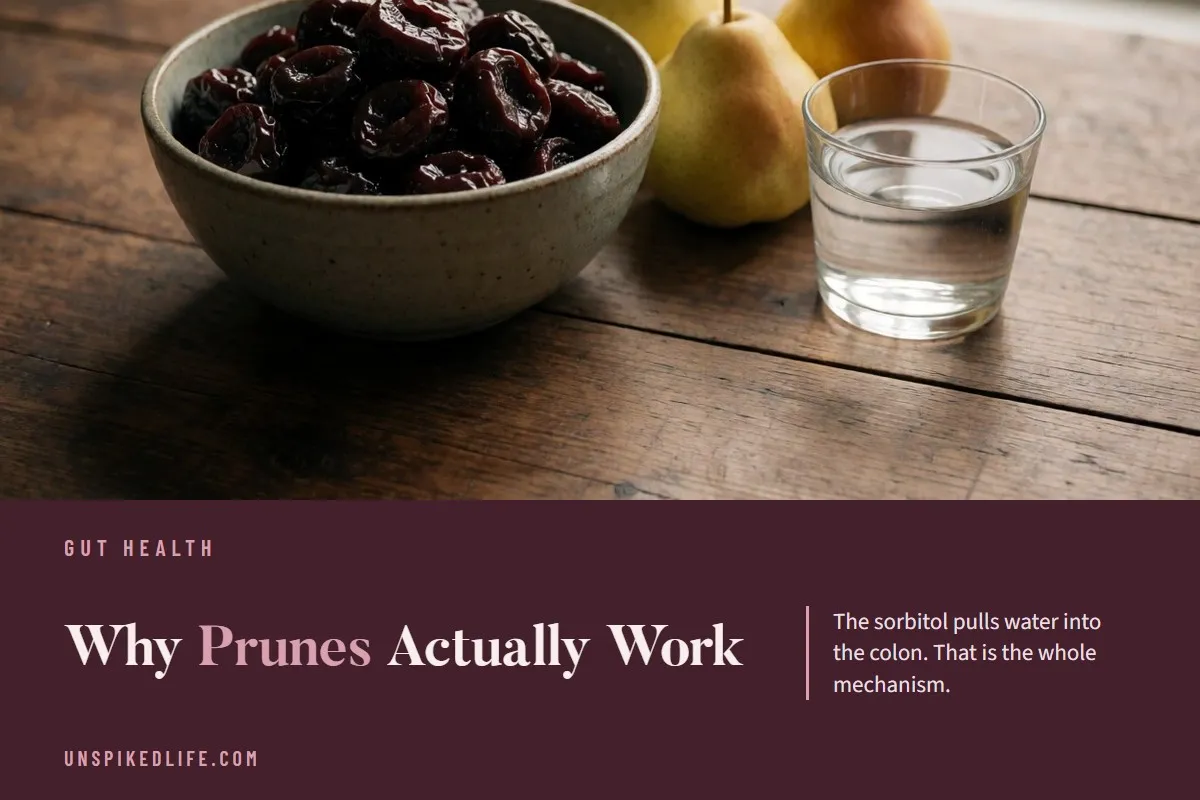
Everybody has been told to eat prunes, and nobody has been told why.
That is a small thing, but it is the reason the advice slides off. It is something your grandmother said, passed on with a slight air of embarrassment. It sits on a shelf with a dozen other bits of folk wisdom that may or may not be true. So you either do it half-heartedly or you buy something from a chemist instead.
There is a mechanism, and it is worth two minutes. Here it is, along with five other things that work, roughly in order of how little effort they take.
1. Prunes, and what the sorbitol is doing
Prunes contain sorbitol, which is a sugar alcohol your small intestine absorbs very slowly.
Because it is absorbed slowly, a good amount of it travels the whole way down to your colon. And once it is there, it pulls water in with it. More water in the colon means softer contents, and softer contents move.
That is it. Not fibre, not magic. Water, pulled in by something your body does not absorb quickly. The dried fruit is simply the easiest way to eat a useful amount of it.
Pears do the same thing more gently. Pear juice is the milder version, which matters if prunes have been too much for you in the past, or if you are doing this for a child.
Practical: a small handful, not a bowl. This is dose-related, and the person who eats fifteen prunes in one sitting learns that lesson properly.
Give it a day or two rather than an hour. Nothing on this page works in twenty minutes, and the things that do are the ones in the last section.
2. Two kiwis a day, skin on
Kiwi has been studied for this specifically, and the trials link it to more frequent and easier bowel movements.
Two a day is the amount that keeps coming up in the research. Eat the skin. It is fuzzy and nobody likes the idea, and it roughly doubles the fibre. Rub it under a tap, or use a gold kiwi, which has a smoother skin and tastes sweeter.
Of everything on this page, this is the one that feels least like a remedy and most like fruit. That matters more than it sounds, because a remedy gets abandoned in a fortnight and fruit does not.
3. Something warm, first thing
There is a reflex called the gastrocolic reflex. When your stomach fills, it sends a signal to your colon to move things along. It is the reason people need the bathroom after breakfast rather than at random times of day. Your gut is on a schedule, and the schedule starts when you eat.
Warm liquid on an empty stomach sets it off. It has to be warm. Cold water does not do this in the same way.
Black coffee does it too, and there is decent evidence behind it. The evidence is for black coffee rather than the version with sugar and cream, and decaf still works, which tells you the caffeine is not really the point.
Practical: a mug of warm water or black coffee, sitting down, first thing. Lemon is optional. It mainly makes people drink more of it, which is the actual benefit.
4. Put a stool under your feet
This is the cheapest thing on the page and it works tonight.
When you sit upright on a toilet, there is a kink in the last part of the bowel. It is there by design, and it is part of what keeps everything in place the rest of the time.
Raising your knees above your hips straightens that angle out. Less kink, less straining, less time sitting there.
Practical: any small step stool. A stack of books works. So does an upturned washing-up bowl. You do not need the branded one. You need eight inches.
Nobody talks about this one, which is a shame, because it is the only thing on the page that costs nothing and changes something the same evening.
5. Fibre, but low and slow
Here is the nuance that almost every article leaves out, and it matters.
Fibre keeps things moving once they are moving. It does not restart a system that has stalled. So piling in a lot of fibre when you are already backed up makes things worse first. It sits there and ferments, and you end up more bloated than when you started.
If that has happened to you, you did not do it wrong. You were given half the instruction.
Start low, go slow. A small increase, held for a week, then a bit more. Water alongside it, because fibre without water is the other half of that same problem.
And soluble fibre is the one for this job. Psyllium holds water and keeps things soft and moving. Wheat bran works differently, by drawing water and secretions into the gut, which is a different job and not always the one you want. If you have been eating bran cereal every morning for a year and nothing has improved, that may be why. It was not the wrong idea. It was the wrong fibre for the job.
Two foods worth knowing:
Legumes. Lentils, chickpeas, beans. They give you fibre, fermentable fibre and food for your gut bacteria in one go, which is the widest coverage available from a single food.
Flaxseed. One to two tablespoons a day, ground. A little goes a long way, and it carries an anti-inflammatory fat as a bonus.
6. Move, daily
Exercise increases blood flow to the colon and drives the muscle wave that pushes things along.
About thirty minutes, split however suits your day. It does not need to be one block, and it does not need to be hard. The walking you would already do counts, if you actually do it.
This is the same ten minutes after a meal that shows up everywhere else on this site, doing a second job. It is rare for one habit to pay twice.
What to leave alone
Two honest warnings, because this category is full of things sold as gentle that are not.
Senna and aloe vera juice are rescue tools. Both are stimulant laxatives. Fine to get over a hump, not fine as a daily habit. The daily tools are food, water and movement.
And if none of this works, it may not be the colon. Most slowness is a slow colon, which is what everything above addresses. But sometimes the muscles at the exit will not relax, and that is a different problem with a different fix. Worth saying to your doctor rather than adding a seventh remedy.
Start with one
Put a stool under your feet tonight.
It costs nothing, it changes nothing about what you eat, and you will know within two days whether it helps you.
If you want a second one, make it the warm drink in the morning. Those two together are free, and between them they cover the exit angle and the reflex that starts the whole business.
Leave the fibre until last, and when you get to it, go slowly. That is the one where rushing makes things worse rather than slower.
This article is education, not medical advice. Nothing here is an assessment of you or your health. Talk to your doctor before changing anything, especially if you take any medication.
This is general education about food and daily habits, not medical advice. Talk to your own clinician before changing anything, particularly if you take prescribed medication.