Beans At Lunch Make Dinner Easier
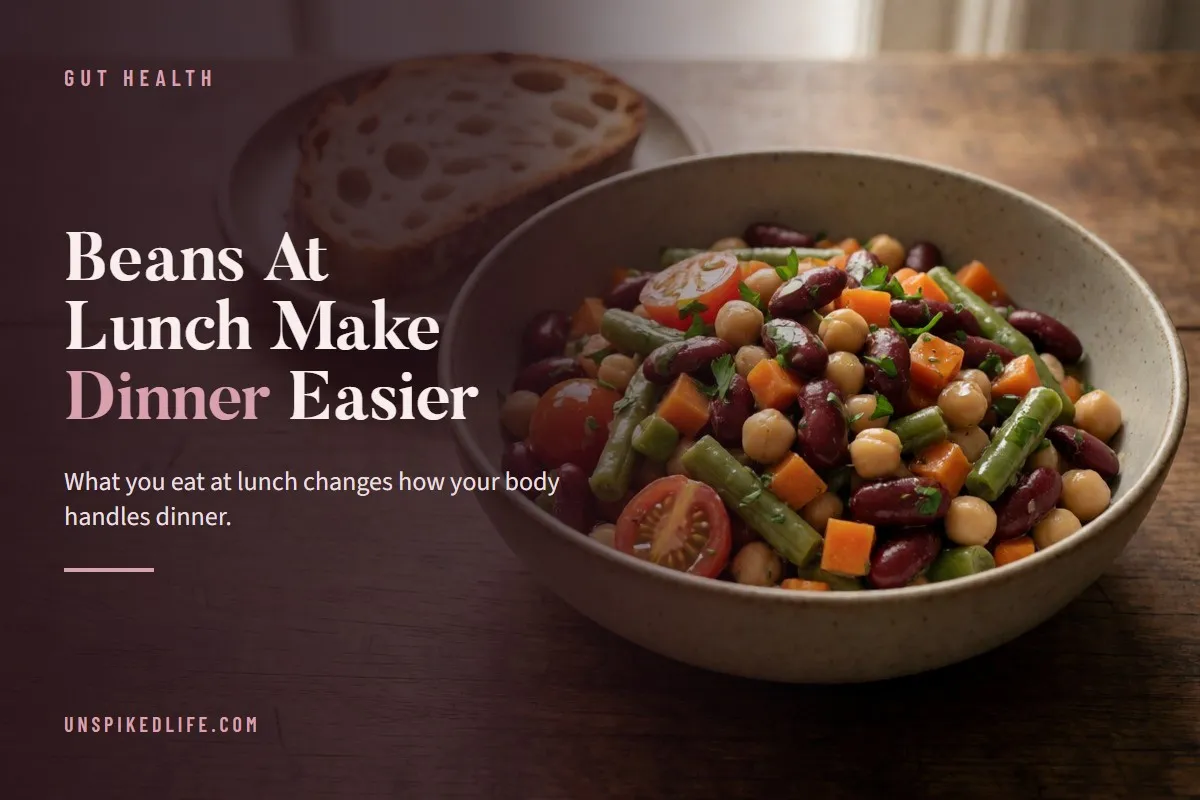
Almost everything you will read about steady energy works inside one meal.
Eat in this order and this meal behaves better. Add fibre to this plate and this plate is gentler. Walk after this dinner and this dinner lands more softly. All true, all useful, and all of it stops at the edge of the plate it started on.
This page is about the exception. What you eat at lunch changes how your body handles what you eat at seven. It is the only thing on this site that reaches forward into a meal you have not cooked yet.
1. What actually happens
Eat legumes at one meal, and the meal after it produces a smaller rise than it otherwise would.
Beans, lentils, chickpeas, split peas. The fibre in them is not absorbed by you at all. It travels down to your gut bacteria, who ferment it. The compounds they make while doing that improve how your body signals about fuel for several hours afterwards.
So the effect outlives the lunch. It is still working at dinner, because the bacteria are still working at dinner.
This has a name in the research. It is called the second meal effect, and it has been described for a long time. It is just not something anybody tells you at the supermarket.
2. Which gives you two useful moves
Beans at lunch, and dinner is easier. This is the one most people can act on, because lunch is the meal you eat alone and can change without consulting anybody.
Beans at dinner, and the morning is easier. Less obvious, and worth knowing if your problem is that breakfast leaves you flat by ten.
That is the whole practical instruction. Everything below is about making it happen without turning your week into a project.
3. This is where food and gut health meet
Everywhere else on this site, food and gut health sit next door to each other. This is where they turn out to be the same subject.
It is also why this page lives under gut health rather than under food. The beans are the delivery mechanism. The bacteria are what actually does the work.
The mechanism is not really about the beans. It is about what your gut bacteria do with the part of the beans you cannot digest. They are doing the work, and the second meal is where you notice it.
Which means the same rule from the gut page applies here. A population that is not used to legumes will be noisy about them for a week or two. That is the kitchen re-staffing, not a verdict on beans, and it is the reason the next section is about half tins rather than whole ones.
4. Three cheap ways to get legumes into a day you already have
None of these are recipes. All three go into food you were already making.
Half a tin, rinsed, into something. Bolognese, soup, a curry, a stew, chilli. Rinsed black beans or chickpeas disappear into anything with a sauce, and half a tin is enough to matter. Nobody at the table comments.
Lentils in the soup. Red lentils dissolve completely in about twenty minutes and thicken whatever they are in. If you make soup at all, this costs you nothing but the twenty minutes it was already going to simmer for.
Hummus as the fridge default. A tub of hummus and whatever raw vegetables you have is a lunch, and a snack at four. It gets chickpeas into a day without cooking anything at all. Buy the plain one, and buy the big tub.
Start with one of the three, at one meal, twice this week. Not all three, and not every day.
The tinned version is fine, by the way. Dried beans are cheaper, and better if you enjoy that sort of thing. But a tin you actually open beats a bag of dried chickpeas that sits in the cupboard until spring.
5. If beans do not agree with you right now
Some people find legumes uncomfortable, and being told to eat more of them is not helpful.
Two things are worth separating.
If they have never agreed with you, that is real, and it is worth taking seriously.
If they used to be fine and now are not, the discomfort is more likely to be the adjustment described above. Same if you simply have not eaten many for years. That usually settles within a couple of weeks.
Either way, start small. Half a tin split across two meals, rinsed well, in something cooked. Give it a fortnight before you decide anything. If beans give you trouble today, that is information about today, not a permanent verdict, and it often changes as the rest settles.
And if anything is severe or keeps going, that is a question for your doctor rather than for a page on the internet.
6. Where the rest of your fibre comes from
Legumes are the ones with the forward reach, but they are not the only fibre that matters. Fibre does two jobs at once: it slows how fast a meal arrives, and it feeds the bacteria doing the work above.
Some easy sources, for scale rather than as a target to hit:
- A cup of cooked lentils or black beans is a large contribution on its own
- Two tablespoons of chia is a surprising amount, and it disappears into yoghurt or oatmeal
- A cup of raspberries carries more than most people expect
- Oats, oat bran and ground flax all count, and all cost very little
Variety matters more than the total. The same fibre from the same food every day feeds the same narrow group. Beans one day, oats the next, a different vegetable at the weekend does more than a bigger portion of the one you always eat.
7. Why this one is worth the trouble
Most of what you can do about steady energy has to be done again at every meal. Order the plate again. Add the fibre again. Walk again.
This one does not. You do it once, at lunch, and it is still working while you cook dinner. That is the hour when you are least likely to be making careful decisions about anything.
That is the case for beans in one sentence. The meal where you have the most control is not the meal where you need the most help. This is the one thing that carries help from the first to the second.
Six o’clock, tired, with people to feed, is where most good intentions actually die. Lunch is much easier to change than that.
8. The other thing that reaches forward
While we are on things that outlast the meal: a walk does it too.
Ten to twenty minutes after your largest meal, at an ordinary pace. Working muscle pulls glucose out of the blood directly, without waiting for the usual signal, which is why it works even when other things have not. And the effect is not over when the walk is. Muscle that has just been used keeps restocking for a day or two afterwards, and stays more responsive while it does.
So beans at lunch and a walk after dinner are doing similar work from opposite ends. Neither requires you to eat anything less.
Start with lunch on Tuesday
Half a tin of chickpeas, rinsed, in whatever you were having. Then notice how seven o’clock feels compared with a normal Tuesday.
One meal, one addition, nothing removed. If it goes well, do it again on Thursday.
That is the entire plan, and it is meant to be this small. The version with a shopping list and a new recipe is the version that stops in week two.
This is general education about food and daily habits, not medical advice. Talk to your own clinician before changing anything, particularly if you take prescribed medication.