What To Drink Instead Of The Three O'Clock Can
It is ten past three. The meeting ran over and your eyes are heavy. There is a can in the fridge, and it has been there every afternoon for about six years.
It helps. For about forty minutes it really does help. Then you are more tired than you were before, and there is still a lot of the day left.
That is not you being weak about sugar. It is what a sweet drink is built to do. And there are drinks that give you most of the good part without the fall.
1. Ten teaspoons, with nothing to slow them down
A regular can of fizzy drink holds about ten teaspoons of sugar. That is close to a quarter of a cup, poured in all at once.
What makes it land so hard is not only the amount. It is that nothing comes with it.
When you eat sugar in food, other things come with it. There is fibre, protein or fat, and they slow how fast the meal gets into your blood. A drink has none of that. It goes straight in. You get a fast rise, and then a fast fall, and the fall is the three-forty slump.
Juice, sports drinks, energy drinks and sweet iced teas all work the same way. So does the large coffee drink with syrup in it. They are all sugar you drink, and the body gets through it fast.
2. The half of the story that happens in the liver
There is a second part that most people never hear.
The sugar in most sweet drinks is partly glucose and partly fructose. Glucose goes into the blood and any cell can use it. Fructose is different. Only the liver can deal with it.
A little fructose, as in a piece of fruit with its fibre, is easy work. A can of it, arriving in one go, floods the liver. And a liver with more fructose than it can use turns the extra into fat. That fat can build up in the liver itself.
A liver carrying extra fat handles the rest of your blood sugar less well. So the can hits twice. Once in the blood, straight away. And once in the liver, slowly, over the months.
3. What about the diet can?
The diet can has no sugar, and swapping to it is a real step down from the full-sugar one. It is not nothing.
It is also not a clean swap. It keeps the taste for very sweet things going, and people who drink it often find they still reach for the biscuit. There is also early research on what some sweeteners may do in the gut. That research is not settled. Nobody can tell you yet how much it matters.
So think of the diet can as a stepping stone. It is a fine place to be on the way to something else. It is just not the place to stop.
4. What to drink instead
None of these are special products. Most of them are already in the shop you go to.
Sparkling water. You get the fizz and the cold, which is half of what the can was giving you anyway. Plain or flavoured, as long as the flavoured one has nothing sweet added.
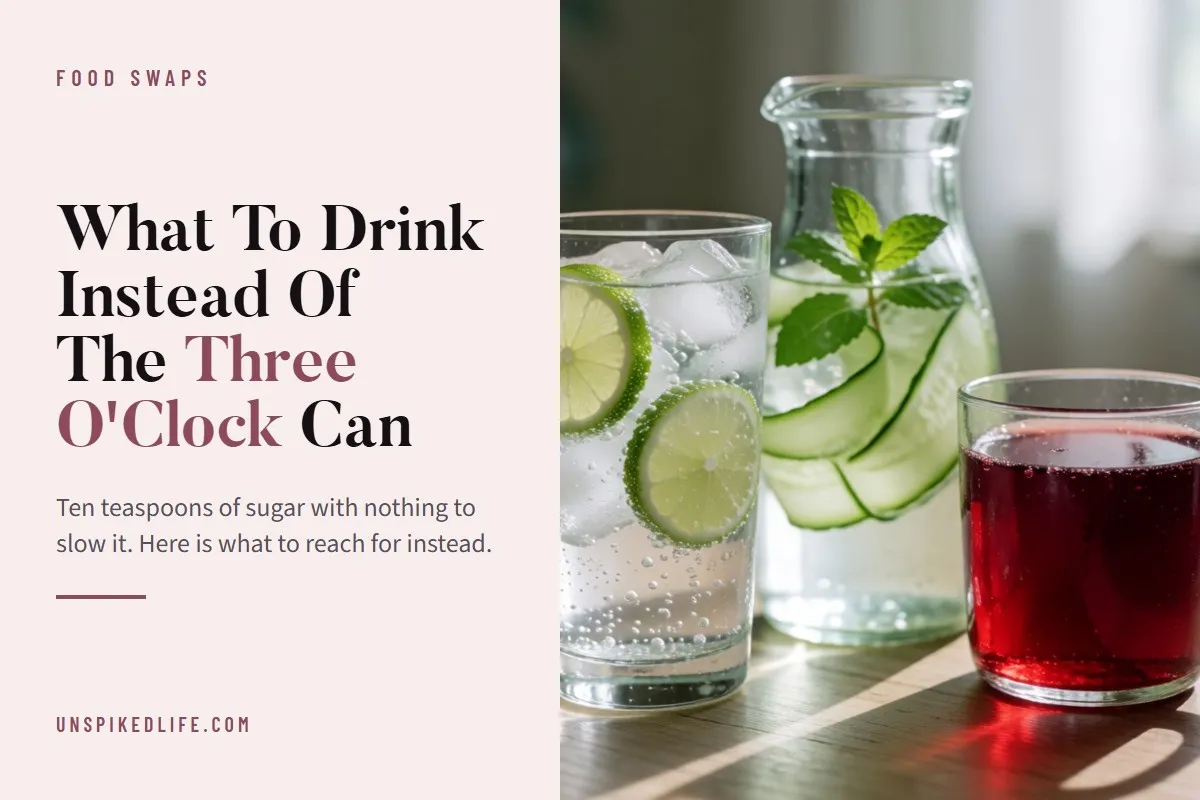
Sparkling water with something in it. A squeeze of lime. A few slices of cucumber. Some crushed berries or a sprig of mint. Make a jug in the morning and it tastes better by three.
Herbal tea, hot or iced. Peppermint, chamomile, hibiscus. Iced hibiscus is a deep red and slightly sour, and it looks like a proper drink.
Coffee or tea, without the syrup. Black, or with a splash of milk. The problem with coffee drinks is almost never the coffee. It is the syrup and the sweet creamer.
Lower-sugar soda alternatives. There are now fizzy drinks made with far less sugar, some with added fibre. They are a real middle step. Read the label on each one, because they are not all the same, and three of them in a row adds up to one full can again.
5. Coconut water, halved
Coconut water gets sold as a health drink. It does have useful minerals in it. It also has sugar.
It is much less than a can of soda, and that is a fair reason to pick it. But there is an easy way to make it better. Pour it half and half with plain water. It still tastes of coconut, it is still cold, and you have halved the sugar without noticing.
Look for one with nothing added. The label will say 100 per cent coconut water.
6. The one line on the label that matters
Turn any drink over and find the nutrition panel. Under the total sugar, there is a line for added sugars.
For a drink, the number to look for is zero.
Total sugar can include what is naturally in fruit or milk. Added sugar is what was put in at the factory. A drink with a lot of it is a sweet drink, whatever the front of the bottle says about vitamins, electrolytes or energy.
7. Replace one, not all of them
Here is where most people go wrong. They decide on Sunday night that the cans are finished. By Wednesday they are back, and it feels like failing.
It was not failing. It was changing too much at once.
If you drink three cans a day, swap one. Just one. Make it the afternoon one, since that is the one that sets up the slump. Keep the other two for now.
After a week or two, the swap will feel normal, and your taste for sweet things will have eased off a little. That is the point to swap the next one.
8. Why the craving eases off
The first few days without the afternoon can are the hardest, and it helps to know why.
Part of what you are missing is the sugar. Part of it is the habit: the walk to the fridge, the hiss of the can, the five minutes away from the screen. And part of it, for most sweet drinks, is the caffeine, which is why a headache on day two is common and nothing to worry about.
Sparkling water in the same fridge, at the same time, keeps the habit and the break. A cup of tea keeps the caffeine. What you are left missing is the sugar on its own, and that is the part that fades.
Your sense of sweet adjusts to what you give it. After two or three weeks with less, the old can often tastes far sweeter than you remember. Many people are surprised by that. It is a sign the swap has settled in, not that you have lost something.
Start with one
Tomorrow at three, have a cold can of sparkling water ready in the fridge, next to the usual one. Add a squeeze of lime if you have it.
Drink that one first. If you still want the other can after, have it. No rules.
Then notice how you feel at four. Most people find the slump is smaller. Some find they did not want the second can at all. Either way, you have learned something about your own afternoon.
Keep the swap for a week before you change anything else.
This is general information about food and daily habits, not medical advice. Talk to your doctor before changing anything, especially if you take medication.
This is general education about food and daily habits, not medical advice. Talk to your own clinician before changing anything, particularly if you take prescribed medication.