What Is Actually In Your Cereal
It is ten in the morning and you are starving. You had breakfast at seven. A proper bowl, from the box with the whole grain badge on the front.
So you have a biscuit with your coffee, and then feel bad about the biscuit.
The biscuit is not the story here. The bowl is. And it is not your fault, because the box was designed to make you think you had made a good choice.
1. What refining does to a grain
A grain, as it grows, has an outer layer of fibre, a small store of fat and protein, and a large middle made of starch.
Refining takes the outer layers off. What is left is mostly the starch. Then, for a lot of cereals, that starch is ground up, cooked and puffed into a hoop or rolled into a flake.
That process strips out the two things that would have slowed it down. The fibre is gone. The structure is gone. Your body has very little work left to do. It is a bit like the food has been half digested before it reaches you.
So it goes in fast. Blood sugar climbs quickly, then drops quickly. The drop is ten o’clock. The drop is the biscuit.
2. Hungry at ten is the bowl, not you
It is worth stopping on that.
A lot of women read mid-morning hunger as a lack of discipline. It is not. It is what a fast-digesting breakfast does. A breakfast with protein and fibre in it digests slowly, and it holds you until lunch without you having to try.
You can test this yourself. Have your usual cereal one morning and eggs on wholemeal toast the next. Note the time you first feel hungry. Most people find a gap of an hour or more.
3. Why the rest of the day follows the bowl
The mid-morning dip does not stay in the morning. It tends to set the pattern for the hours after it.
Hungry at ten, you grab whatever is closest, and in most offices that is something sweet. That brings its own rise and fall, so by lunch you are hungrier than you would have been. You eat a bigger lunch, faster, and the three o’clock slump arrives right on time. By the evening you are tired, and tired people snack.
None of that was a series of bad choices. It was one fast breakfast, echoing through the day. Change the bowl, and a lot of the rest often changes on its own.
4. The front of the box is marketing
The front of a cereal box is an advert. It is allowed to say things that are true in a narrow way and still leave the wrong picture.
“Made with whole grain” can mean some whole grain, not mostly whole grain. “Good source of fibre” can sit on a box that is also high in sugar. “Heart healthy” is about one feature, not the whole food. The cartoon, the sunrise and the wheat field are there for a reason.
None of that is on the back. The back has to tell the truth.
5. Read the ingredients first
The ingredients list is ordered by weight. What is first is what there is most of.
So read the first three. If sugar is one of them, the cereal is sweeter than it looks. Sugar also hides under other names: glucose syrup, honey, cane juice, malt extract, dextrose. Two or three of those, spread down the list, can add up to more than any one ingredient.
A cereal worth keeping usually has a short list. Oats, and not much else, is a good sign.
6. Then find three numbers
Turn to the nutrition panel. You only need three numbers from it.
Fibre. Aim for at least 5 grams a serving. Below that, it is not doing much to slow the rest.
Added sugars. This line sits under total sugars. Aim for under 5 grams a serving. Total sugar can include milk or fruit. Added sugar is what the factory put in.
Serving size. This one is the trap. Check how many grams a serving is, then pour your usual bowl onto the kitchen scale once. Most people pour two or three servings. The numbers above were for one.
If a box clears the first two and you still eat a reasonable bowl, it can stay.
7. The cereal that looks the most sensible
Raisin bran is the cereal people pick when they are trying to be good. It has fibre. It has fruit.
It also has a lot of added sugar for a single cup, and the raisins bring more sugar on top. It is a lot better than the chocolate hoops. It is a lot worse than the badge suggests.
This is the pattern with most cereals. The ones that look sensible are usually sweeter than they seem. The ones that look plain are usually the ones worth having.
8. What to have instead
These breakfasts are cheaper than most boxes, and every one lasts longer.
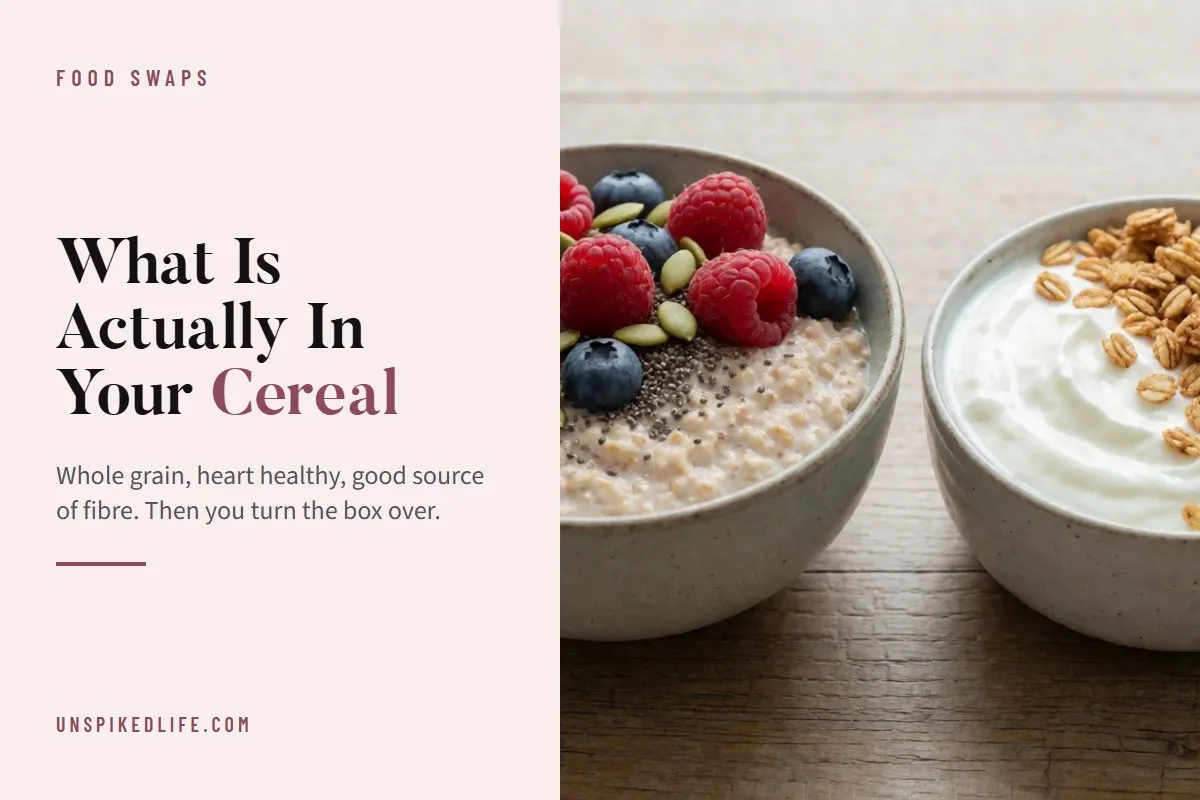
Porridge made from rolled or steel-cut oats. Not the flavoured sachets, which are often mostly sugar. Stir in a spoon of chia seeds or a scoop of Greek yoghurt for protein. Top with berries.
Greek yoghurt with berries and seeds. Plain yoghurt. Add the fruit yourself.
Eggs, any way you like them, with wholemeal toast or some spinach on the side.
Chia pudding, made the night before with milk and a few berries.
If you love your cereal and do not want to lose it, keep it and change the bowl. Pour half your usual amount, then top it with plain Greek yoghurt and a handful of nuts. The protein and fat slow the rest down, and you still get the crunch.
9. Granola is cereal too
Granola deserves its own warning, because it has the best reputation and often the worst label.
It looks like the healthy option. Oats, nuts, seeds, a bit of dried fruit. And some granola really is fine. But most of what is on the shelf is bound together with sugar, honey or syrup, then baked in oil so it turns into clusters. That is what makes it taste so good, and it is also why a small bowl can carry more added sugar than a lot of children’s cereals.
The serving size on a granola box is often tiny, sometimes 30 or 40 grams, which is about a quarter of what most people pour. So the numbers on the panel look reasonable, and the bowl in front of you is three or four times that.
If you love granola, use it as a topping, not the bowl. A small spoonful scattered over plain Greek yoghurt gives you the crunch and the taste, and the yoghurt carries the protein that makes the whole thing last.
10. Why this matters more at breakfast
Breakfast sets up the day. A fast-rising, fast-falling breakfast tends to lead to a mid-morning snack, then a hungry lunch, then a slump at three. A slow, steady breakfast tends to make the rest of the day easier, without you doing anything else.
That is why breakfast is often the best first change to make. It is one meal, and you control it. Nobody else is choosing your cereal.
Start with one
Take your cereal box out of the cupboard this evening. Turn it over. Read the first three ingredients, and find the fibre and added sugar lines.
Then weigh your usual bowl once.
That is the whole job for today. You do not have to change anything yet. Just know what is actually in it. Most people make the swap on their own once they have seen the numbers.
This is general information about food and daily habits, not medical advice. Talk to your doctor before changing anything, especially if you take medication.
This is general education about food and daily habits, not medical advice. Talk to your own clinician before changing anything, particularly if you take prescribed medication.