Strict Is What Causes The Binge
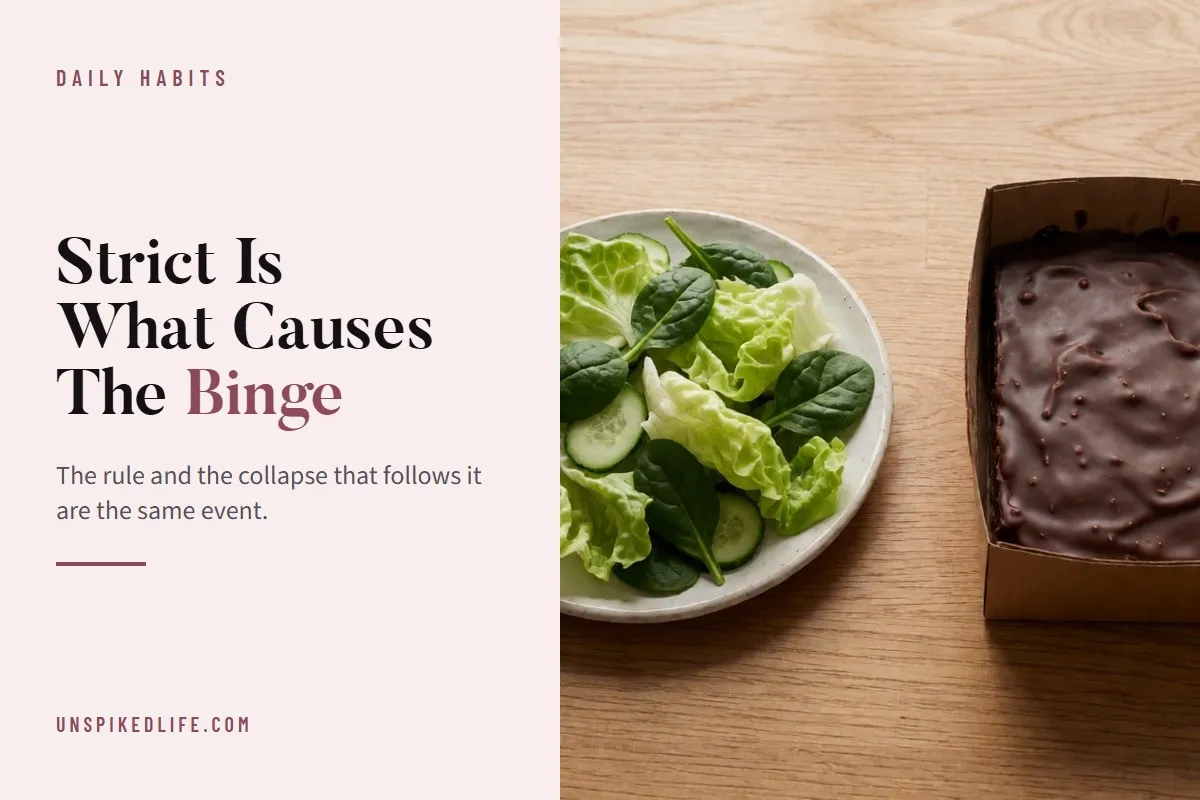
You were good for nine days.
Then Tuesday happened. By half nine you were standing in the kitchen eating things you would not have chosen if anyone had asked you, and not really tasting any of them. Wednesday morning you decided the whole thing was pointless, because clearly you cannot be trusted with it.
That is the part worth arguing with. Not the Tuesday. The conclusion you drew on Wednesday.
1. The rule and the collapse are the same event
Rigid restriction produces the binge. It is not a personal failing that happens to occur near a rule; it is a predictable result of the rule.
Here is the shape of it. You make a list of foods that are not allowed. Every one of them becomes more interesting than it was, because you now think about them on purpose. Then one of them is eaten, at half nine on a Tuesday, and the situation is no longer about a biscuit.
Because the rule was absolute, breaking it once reads as total failure. There is no partial state. You were either doing it or you have blown it. And since you have blown it, tonight does not count, so the rest of the packet does not count either. That is a rule talking, not an appetite.
The all-or-nothing structure is doing this, not you. A person with the same appetite and no rule eats two and puts the packet away.
You have probably watched somebody do exactly that and wondered what is wrong with you. Nothing is. They were not holding a line, so there was no line to lose.
2. Willpower has a shelf life
The other reason strict does not work is duller and more decisive.
Willpower is finite. It runs down through the day, and it runs down faster when you are tired, hungry or upset, which is most evenings after a real day.
So any plan built on holding out has an end date built into it from the first hour. You cannot see the date, but it exists, and it usually falls somewhere in week three.
That is why the drastic version always fails at about the same point regardless of who is doing it. It is not a lack of resolve. The plan was spending a resource nobody has an unlimited amount of, and it spent it faster on the days that were already hard.
Anything that has to be decided again every evening will eventually be decided the other way. Anything that has become the thing you just do will not.
3. Some foods are built so the stop signal never comes
Part of the Tuesday is not psychological at all.
Fullness works partly on volume. Fibre acts like a sponge in the stomach, takes up room, and that physical volume is a large part of what tells you to stop.
Ultra-processed food is engineered in the opposite direction. It is soft, it is dense, it is quick to eat, and it carries very little of the fibre or water that would take up room. So the stop signal arrives late, or does not really arrive at all.
So eating a lot of it feels like a loss of control. What actually happened is that the mechanism which ends a meal was never given anything to work with.
Knowing this is worth more than one more rule. If a food is built to be eaten past the point of stopping, then eating a lot of it says nothing about your character.
4. Flexible restraint is the thing that holds
The alternative to a rigid rule is not no rule. It is a rule that can bend without breaking.
Control the portion at the moment it happens, rather than trying to make sure the moment never happens. That is the whole of it.
In practice: the biscuits are not banned. You have two, with a cup of tea, sitting down, on a Tuesday. Nothing has been broken, because nothing was declared, so Wednesday is an ordinary Wednesday.
This is less satisfying than a proper plan. It has no start date and nothing to announce. It also has no collapse in it. Over a year, the difference between a method that runs for fifty-two weeks and a method that runs beautifully for three and then stops is not close.
5. Start from what you already do
The other half of this is where you start from.
Most plans describe the eating of a person you are not, living a week you do not have. Then the gap between that and Tuesday is crossed in one leap, on a Monday, with a lot of enthusiasm.
The better move is to start from what you are already inclined to do and adjust one thing about it. If you always have toast, keep the toast and put something with protein on it. If you always snack at four, keep snacking at four and change what is in the cupboard at four.
Something small enough to become automatic. If it still feels like effort after three weeks, it was too big a step, and that is information rather than a verdict.
Then make the next adjustment from the new starting point. This is slower than a plan and it is the reason the slow version is still running in March.
6. This is why nothing here is banned
It is worth saying plainly what this means for everything else on this site.
Nothing is on a forbidden list. Not bread, not potatoes, not the biscuits. Every article here is about sequence, timing, form and what goes alongside, because those are changes that do not need defending at half nine on a Tuesday.
Eat the potato, boiled and cooled and reheated. Eat the bread, sprouted, with something on it. Eat the protein first. None of that has a breaking point, because there is nothing in it to hold out against.
That is not a softer approach dressed up. It is the approach that is still in place next year.
7. What to do about the Wednesday
Because there will be another Tuesday.
Do not skip breakfast the next morning to make up for it. Under-eating after a big evening reads to your body as a shortage, and it answers with the hormones that raise blood sugar and make you hungrier by eleven. The correction becomes the cause of the next one.
Eat a normal next meal. Vegetables, a legume, some protein, a whole-food starch, not much added fat. That is the reset, and it is deliberately unremarkable.
Then carry on. Not restart, carry on. There was nothing to restart, because nothing had actually stopped.
Start with one
Take one food off your not-allowed list this week, and eat a normal portion of it on purpose.
Sitting down, on a plate, not standing at the counter. Once. That is the exercise, and it will feel much worse in advance than it does at the time.
What you are testing is not the food. It is whether a thing you have eaten deliberately still has the pull it had when it was forbidden. For most people it does not, and that is the mechanism working in your favour for once.
One change at a time, as always. This one counts as your change for the fortnight.
This article is education, not medical advice. Nothing here is an assessment of you or your health. Talk to your doctor before changing anything, especially if you take any medication.
This is general education about food and daily habits, not medical advice. Talk to your own clinician before changing anything, particularly if you take prescribed medication.