Frozen Is Not A Compromise
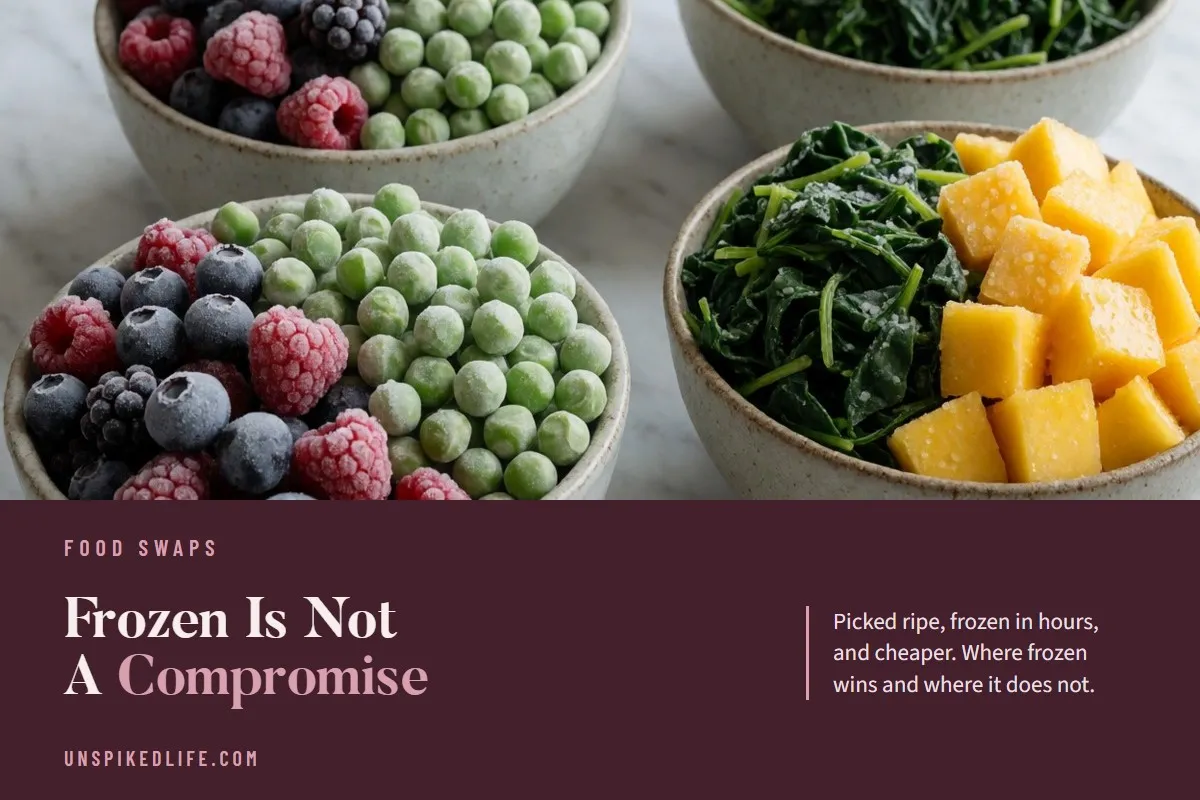
There is a small apology that happens in front of the freezer.
You put the bag of berries in the trolley. Something in you notes that fresh would have been better, and that you are doing this because it is cheaper. Cheaper feels like a compromise. Then you go home and feel slightly worse about a perfectly good bag of berries.
You can stop doing that. The apology is based on a picture of how fresh food reaches a shop that is thirty years out of date.
1. Ripe, then frozen, within hours
Fruit and vegetables for the freezer are picked when they are ripe and frozen within hours of coming off the plant. That is the whole point of the supply chain. Ripe is when it freezes best and tastes best, so there is no reason to pick early.
Fresh produce is different. A great deal of it is picked before it is ripe. That is so it survives being packed, chilled, driven, sorted and shelved, and is still saleable four days later.
Which means the bag in the freezer is often the riper food. Not always, and not for everything. But often.
2. What that does to the nutrients
Vitamins start to decline the moment something is picked, and they keep declining while it travels and while it sits in your fridge.
Freezing more or less stops that clock. So a frozen vegetable holds close to what it had at harvest. A fresh one keeps losing a little every day between the field and your Thursday.
The honest version is that some nutrients survive freezing better than others, and blanching before freezing costs a little of the water-soluble ones. Across a normal week of normal cooking, the difference between the two is small, and it does not run in the direction most people assume.
The much larger difference is between eating the vegetable and not eating it.
3. Berries are the clearest case
Frozen berries cost a fraction of fresh, keep for months, and go straight into things without any preparation at all.
Into hot oatmeal, where they thaw as you stir. Into yoghurt. Into a smoothie, where frozen is better than fresh because you do not need ice. Warmed in a pan for two minutes with nothing added, they become a sauce.
Berries also do a job worth having. They bring fibre with their sugar, and the fibre is what slows how fast the sugar arrives. That is the difference between a berry and a glass of juice, and it survives the freezer intact.
Buy the big bag. It is the cheapest fruit habit available.
4. Vegetables, and the one that people get wrong
Peas, spinach, green beans, sweetcorn, broccoli, cauliflower. All of these freeze well and all of them cost less than the fresh version.
Frozen spinach in particular is worth knowing about. It is already cooked down, so a block is a great deal of spinach for very little money and no washing. It disappears into a sauce, a soup, a curry or a pan of eggs.
Cauliflower rice is the one people give up on, and almost always for the same reason. They steam it plain, taste it, and decide they hate it.
Do it in a hot pan instead. Oil, garlic, salt, and squeeze a lime over it at the end. Cook it until it dries out a bit rather than until it goes soft. Done that way it is genuinely good, and done the other way it is wet and sad and nobody would eat it twice.
5. Fish
Most fish sold as fresh was frozen at sea and thawed for the counter.
Which makes buying it frozen a slightly odd thing to feel bad about. You are buying the same fish at an earlier point, for less money. And you cook it on a day you choose rather than the day it expires.
Frozen white fish goes from freezer to oven with almost no thought. Frozen prawns thaw in a colander under the cold tap in five minutes.
6. The saving that nobody counts is the bin
Here is the cost that never makes it into the comparison.
Fresh vegetables bought with good intentions on Saturday and thrown out on Thursday cost full price and delivered nothing. Most households do this every single week, and most people do not add it up.
Frozen does not rot on a schedule. It waits. So the bag you bought is still the meal you bought it for, three weeks later, on the evening you actually had the energy to cook.
Between the lower shelf price and the food that no longer gets thrown away, this is one of the larger savings available in an ordinary shop.
7. Where frozen genuinely loses
There are real limits, and pretending otherwise would be the same mistake in the other direction.
Salad leaves. Freezing bursts the cells and the leaf goes limp. There is no version of this that works.
Tomatoes and cucumber for slicing. Same problem. Frozen tomatoes are fine for a sauce and useless in a salad.
Anything where the texture is the whole point. A roast potato from frozen is not a roast potato. Soft fruit meant to be eaten raw and whole comes out mushy.
So the rule is simple. If it is going to be cooked, blended or stirred into something, frozen is at least as good and usually cheaper. If it is going on a plate raw and whole, buy it fresh.
8. What to actually keep in there
If the freezer is going to do this job, a short list covers most of it.
Berries. Peas. Spinach. Broccoli or cauliflower, or a bag of mixed. Cauliflower rice. A bag of prawns. Two or three portions of white fish or salmon. Sliced bread, if a loaf goes stale before you finish it.
That is a week of vegetables and three or four dinners, sitting in a drawer, not going anywhere.
The point is not to stock a bunker. It is that the gap between wanting to cook something decent and having anything in the house is where most good intentions die on a Wednesday.
9. The two things worth checking on the bag
Frozen food is mostly one ingredient, which is the point. Two exceptions are worth a glance.
Sauces and coatings. A bag of plain broccoli is broccoli. A bag of broccoli in a cheese sauce, or peas with butter already on them, is a different product at a different price. Neither is wrong. Just know which one you are buying.
Added salt or sugar. Rare on plain vegetables. Common on anything described as seasoned, glazed or ready to roast, and on fruit sold in syrup rather than loose.
The check takes four seconds. Turn the bag over and read the ingredients. If it is one word, you are done.
10. Buy the shop’s own brand
One last thing, because it is free money.
For frozen vegetables, frozen berries, tinned fish and plain yoghurt, the shop’s own label is very often the same product from the same supplier in a different bag. These are commodities. Nobody has a proprietary technique for freezing a pea.
Compare the ingredients lists rather than the fronts of the packets. If they match, buy the cheaper one.
Start with one bag
Not a freezer overhaul. One bag.
Berries are the easiest place to start, because they need no cooking and no decision. Put them in the thing you already eat in the morning.
Keep it for a fortnight and see whether the fruit actually gets eaten, which is the only measure that matters. Fresh raspberries that went furry on Wednesday were never the better option.
And you can stop apologising in front of the freezer. It was never a compromise.
This is general information about food and daily habits, not medical advice. Talk to your doctor before changing anything, especially if you take medication.
This is general education about food and daily habits, not medical advice. Talk to your own clinician before changing anything, particularly if you take prescribed medication.